
Nvidia Stock Had Its Best Day in 23 Years. Huang’s Return Revives the AI Bull Case.
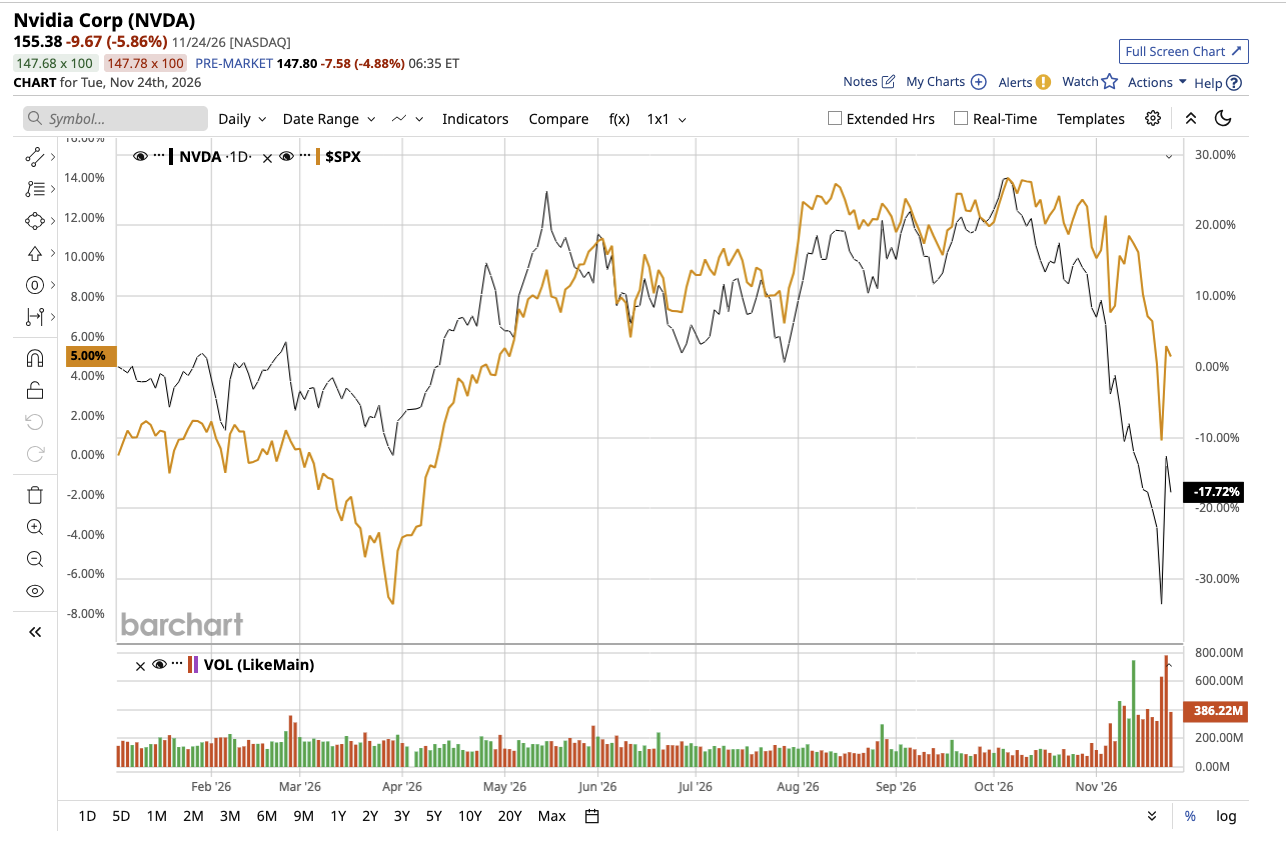
Nvidia (NVDA) investors got an extraordinary surprise on Nov. 23. Just days after Jensen Huang's departure as CEO rattled markets, the company's board reinstated the co-founder, triggering a more than 31% surge in NVDA stock. This marked the stock's biggest single-day gain in 23 years, adding roughly $952 billion to its market value.
Many believe Huang's return has revived Nvidia’s artificial intelligence (AI) momentum, but the company always had a strong AI story. As I noted earlier this month, Nvidia’s core business was already very strong before the leadership change.
Shares of Nvidia are still down 20% so far this year. Is it time to grab NVDA stock now?
Huang's Return Removes One Risk, Not Every Risk
At Nvidia, leadership is not merely important — it is the engine that drives the company forward. This much was evident from the market’s brutal reaction after Huang’s departure. Huang has been the architect of Nvidia's product vision, the mastermind behind its seamless hardware-software integration, and the bridge connecting Nvidia to cloud giants and AI innovators. When he suddenly stepped away amid an affair scandal, the question was not just who would take his place, but whether Nvidia could keep up its momentum and retain customers' trust without its most iconic strategist. Huang's quick return has helped ease those fears and reassure Nvidia's workforce, business partners, and customers.
The CEO's reinstatement followed discussions with Huang and input from senior U.S. government officials on national-security concerns, putting Nvidia's governance and political relationships under greater scrutiny. Yet the market's excitement quickly faded. Following the dazzling rally on Nov. 23, Nvidia shares closed 6% lower the following day and another 4% lower on Nov. 25.
While Huang's return has calmed some leadership jitters, Nvidia still has to deal with several challenges, including government scrutiny and congressional questioning, China export limits, and political pushback to data-center expansion.
The AI Bull Case Was Already in Nvidia's Numbers
Nvidia reported third-quarter fiscal 2027 earnings on Nov. 17, and the numbers offer a stronger reason to own NVDA stock than a leadership headline. Revenue reached $115.8 billion, up 103% year-over-year (YOY) and 20% from the previous quarter. Operating income rose 115% YOY to $77.5 billion, while diluted EPS grew 108% to $2.70. This is significant because Nvidia has moved beyond simply selling more chips. The company is harnessing explosive demand for AI infrastructure and turning it into strong profits. With solid revenue, operating income, and EPS all in the same quarter, Nvidia’s growth is clearly fueling durable gains.
The data-center business remains Nvidia’s main revenue source, accounting for about 93% of quarterly revenue. Data-center sales jumped 110% YOY to $107.6 billion and grew 21% from the previous quarter. Within the segment, hyperscale customers brought in $60 billion, up 23% sequentially, while AI Clouds, Industrial, and Enterprise added another $47 billion, up 18% from the previous quarter and almost three times higher than a year ago. This suggests that while large cloud providers remain Nvidia’s biggest clients, more demand is coming from specialist AI infrastructure companies, enterprises, and industrial users. Nvidia appears to have a broadening market, so its growth isn’t tied to just a few large hyperscalers.
The shift to new products is a key part of the growth story. The Vera Rubin platform brought in almost $20 billion in its first quarter of shipments, making it the company’s fastest product launch ever. Hyperscale partners started using Rubin in about a month, twice as fast as the rollout for Grace Blackwell. Networking revenue also topped $21 billion in Q3. These results show how important Nvidia’s full infrastructure has become, with processors, networking, and integrated systems working together to process more complex AI tasks. This also encourages customers to stay with Nvidia as their computing needs grow.
Management forecast Q4 revenue to be about $130 billion, give or take 3%, and raised its fiscal 2028 revenue growth forecast to 75%, up from 70%. Demand is still higher than supply, with purchase commitments now at $390 billion as of Q3. However, margins remain a concern; GAAP gross margin fell to 74.8% from 75% in the prior quarter and is expected to drop to 71% to 72% in Q4, then recover to 72% to 73% in fiscal 2028. Still, even with margin pressures, Nvidia returned $28 billion to shareholders — $22 billion through buybacks and $6 billion in dividends — and has $227 billion left for future buybacks.
Nvidia's AI Opportunity Remains Bigger Than the Leadership Drama
Nvidia's Q3 numbers make a stronger investment case than the excitement around Huang’s return. Revenue is accelerating, demand continues to outstrip supply, and the Vera Rubin rollout gives the company another growth driver. However, investors should not confuse the recent extraordinary stock rally for an attractive entry point. Nvidia remains one of the strongest ways to invest in the AI boom, but investors would be wiser to gradually build a position rather than rush in after a big jump.
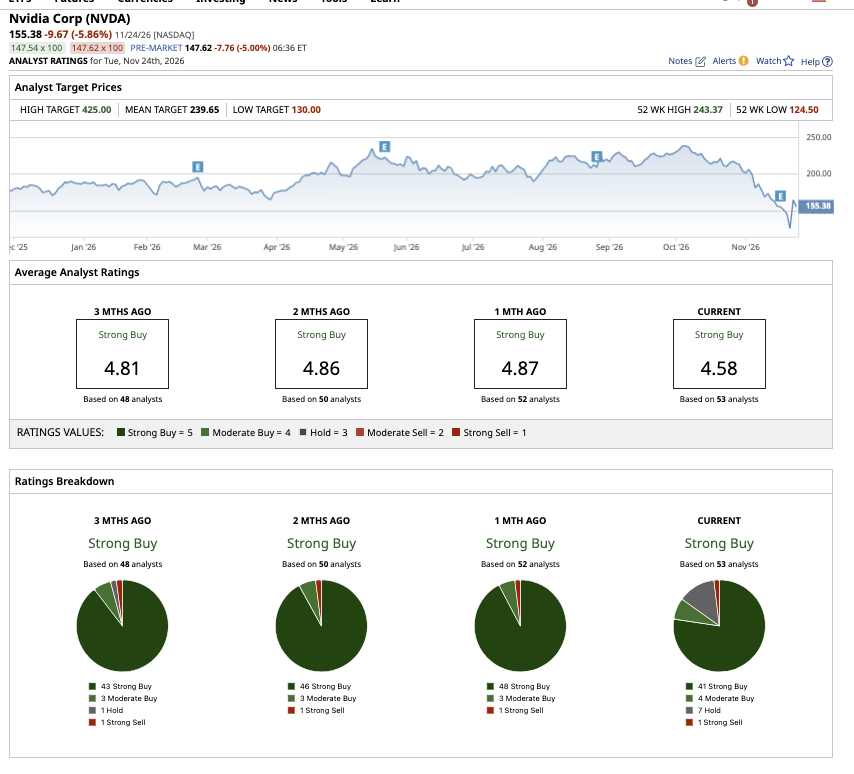
On Wall Street, NVDA stock has a consensus “Strong Buy” rating. Of the 53 analysts covering the stock, 41 recommend a “Strong Buy,” four suggest a “Moderate Buy,” seven have a “Hold" rating, and one analyst has a “Strong Sell.” The average price target of $239.65 suggests potential upside of 61% from current levels, while the high price target of $425 points to a possible 185% increase from here.
On the date of publication, Sushree Mohanty did not directly have a position in any of the securities mentioned in this article. All information and data in this article is solely for informational purposes. For more information please view the Barchart Disclosure Policy here.