
How Unchanged Loan Caps Will Impact Fannie Mae Stock
- Fannie Mae reported that the Federal Housing Finance Agency kept its 2027 multifamily loan purchase cap unchanged at US$88 billion, with at least 50% of those acquisitions required to qualify as mission driven affordable housing.
- This steady cap keeps pressure on how Fannie Mae allocates scarce multifamily capacity across riskier properties, credit risk transfer structures, and mission driven goals, while also managing credit provisions and capital build.
- We will now look at how Fannie Mae's investment narrative could be affected by the fixed 2027 multifamily loan purchase cap.
Federal National Mortgage Association Investment Narrative Recap
To own Federal National Mortgage Association, you need to believe its US$4.1 trillion guaranty book and core guaranty fees can keep supporting earnings while credit costs and housing activity remain in flux, as framed by the analyst consensus narrative on Simply Wall St. The fixed US$88 billion multifamily cap, together with a 50% mission-driven requirement, shapes how much flexibility Fannie Mae has to lean into higher yielding or higher risk segments.
The near-term swing factor is how credit provisions evolve, especially in multifamily where serious delinquencies and provisions have already been highlighted as pressure points. Rising multifamily stress, along with any policy moves on conservatorship or capital, remain the key business risks. The latest FHFA cap decision does not radically change that near-term setup.
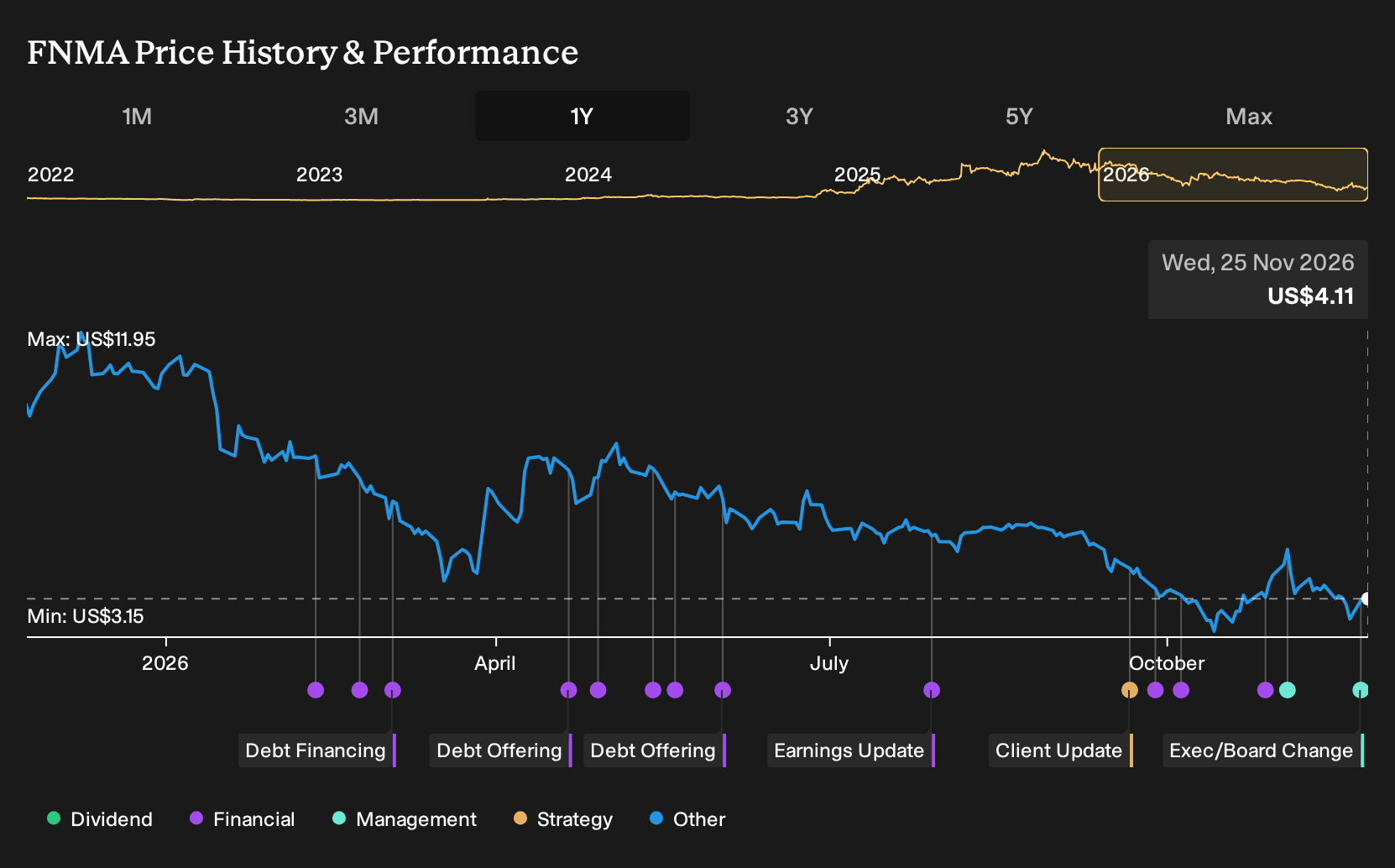
The appointment of David Shafer to the Federal National Mortgage Association board brings another independent voice into an already seasoned group, with the board considered both experienced and majority independent. With credit risk, capital build and conservatorship status all live issues, fresh board capacity matters for overseeing risk transfer decisions, portfolio mix and responses to FHFA directives.
Committee assignments for Mr. Shafer are still to be determined, which leaves some open questions on where his influence will be most direct for now. For you as a shareholder, board-level oversight of rising multifamily provisions, debt funding that is not covered well by operating cash flow, and capital planning could be at least as important to the catalyst path as short-term earnings swings.
Federal National Mortgage Association's narrative projects US$31.8 billion revenue and US$25.6 million earnings by 2029. This implies 4.4% yearly revenue growth and an earnings decline of about US$1.27 billion, from current earnings of US$1.3 billion to the forecast level of US$25.6 million.
Uncover why Federal National Mortgage Association's fair value is consistent with its current price.
Exploring Other Perspectives
One alternate view says the real swing factor for Fannie Mae is capital strain rather than earnings swings. The most pessimistic analysts, before this FHFA decision and David Shafer’s appointment, were modelling about US$32.0b revenue and US$29.4b earnings by 2029, paired with a very low 1.7x P/E. That is a far more cautious stance on valuation. Use that spread in expectations as a prompt to compare several narratives, then decide how this board change and fixed cap might influence your own perspective.
Explore 3 other Federal National Mortgage Association fair value estimates, including one that suggests it could be worth just $4.12.
The Verdict Is Yours
Don't just follow the ticker; dig into the data and build a conviction that's truly your own.
- A great starting point for your Federal National Mortgage Association research is our analysis highlighting 2 key rewards and 3 important warning signs that could impact your investment decision.
- See our latest analysis for Federal National Mortgage Association. The report includes a comprehensive fundamental analysis summarized in a single visual, the Snowflake, making it easy to evaluate Federal National Mortgage Association's overall financial health at a glance.
Looking For More Investment Ideas Beyond Federal National Mortgage Association?
If this Federal National Mortgage Association story has sharpened your view on mortgage credit risk, you can take the next step by widening your watchlist to companies with different balance sheet profiles, cash generation and dividend policies using the Simply Wall St Screener.
- If capital preservation sits near the top of your priority list, you could start with a group of companies that score well on resilience through the 30 resilient stocks with low risk scores.
- For readers hunting for quality at a reasonable price, you can broaden your research with a curated 37 high quality undervalued stocks that blends solid fundamentals with more modest expectations.
- Income focused investors who care about consistency as much as yield can shortlist candidates through a focused 39 dividend fortresses tailored around higher payout opportunities.
Have feedback on this article? Concerned about the content? Get in touch with us directly. Alternatively, email editorial-team@simplywallst.com