
Black Friday Sale: SoFi’s Unusual Options Activity Points to 3 Intriguing Bullish and Bearish Bets
I hope everyone’s Thanksgiving dinners were a success. The football was certainly better than in past years, with all three games coming down to the last few seconds.
Bills kicker Tyler Bass was the star of the day, kicking a 54-yard field goal to tie Kansas City with 12 minutes left and a 57-yarder to win it as time expired. In windy, wet conditions, you couldn’t have written it better.
It’s still early, but the Bills appear ready to challenge for Super Bowl supremacy come playoff time. Nice to see in the first year of their new Highmark Stadium. This Toronto native says, “Go Bills!”
With the markets closed yesterday, today’s commentary is based on Wednesday’s unusual options activity.
Although plenty of storylines caught my attention, SoFi Technologies (SOFI) won because today is Black Friday and investors are looking for deals.
Down 50% in 2026, the fintech’s stock hit a new 52-week low of $11.95 in Wednesday’s trading, making it an ideal candidate for aggressive investors considering potential bargains.
SOFI had eight unusually active options on Wednesday; all but one of them were calls. Based on those eight, here are three option strategies for a bullish or bearish bet.
Have an excellent weekend!
The SOFI Options in Question
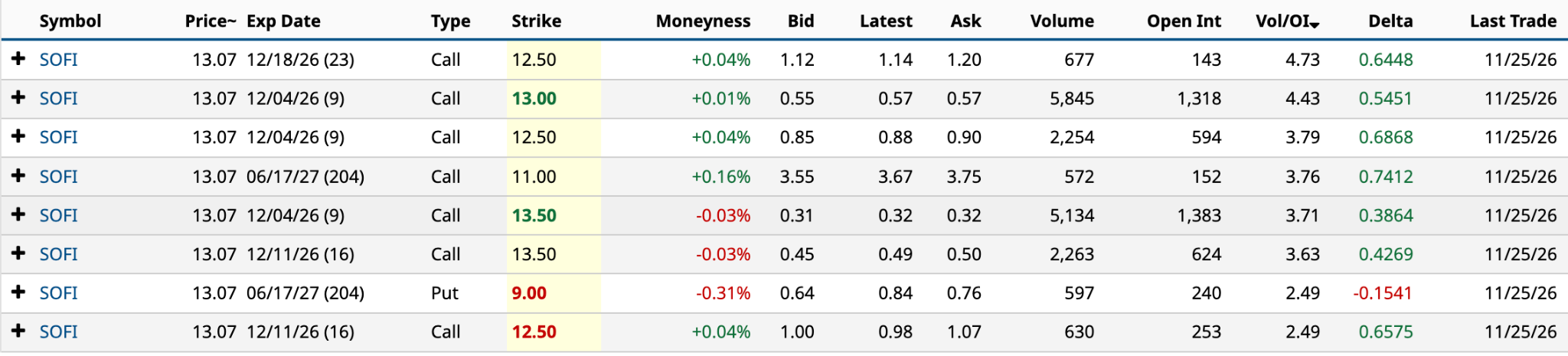
The eight options shown had a volume of 17,972, which was just 4% of the day’s total of 449,663, slightly higher than the 30-day average. The DTEs (days to expiration) range from next Friday to June 17/2027. None had particularly high Vol/OI (volume-to-open-interest) ratios or open interest.
One important point not shown above: the P/C volume ratio on Wednesday was 0.28, which is particularly bullish. That will influence potential options strategies, but first I need to check the options flow to get a better sense of institutional trading.
Options flow shows only two trades of more than 1,000 contracts, 163 with 100 or more, and 13 from 10 to 100. That suggests many retail investors placed smaller bets on Wednesday. Nonetheless, there are enough large trades to get some ideas.
Here are three potential strategies.
Long/Short Gut Strangle
Unlike a traditional Long/Short Strangle, which involves either buying a call and put OTM (out-of-the-money) or selling a call and put OTM, this involves buying or selling a call and put where the call is ITM (in-the-money) and the put is OTM.
This has me focused on the June 17/2027 $11 call and June 17/2027 $9 put.
While both the options flow and time & sales data don’t show any multi-leg matched trades from institutional or retail investors, I’m going with this strategy because it’s more long-term than any of the other six unusually active options. Further, I’m confident I’ve never written about this type of strangle before.
I’m bullish about SoFi’s long-term success. Interest rate concerns have dampened investor enthusiasm for the fintech’s stock, but it continues to add members; it finished Q3 2026 with a record 17.1 million members. From that member base, it expects to generate adjusted net revenue of $6.4 billion, adjusted EBITDA (earnings before interest, taxes, depreciation and amortization) of $2.24 billion, and a 35% EBITDA margin. Its business is progressing nicely.
The long gut strangle here involves buying the $11 call for $3.75 per share (I’m using the ask for both options for simplicity) and buying the $9 put for $0.76 per share, for a net debit of $4.51 per share. That’s also your maximum loss. Your maximum profit is unlimited to the upside and capped on the downside at $4.49 per share [$9 put strike - $4.51 net debit].
The expected move is 30.83%, up or down, by next June.
Based on the $13.07 share price for the last trade on Wednesday, the upside share price at expiration should be $17.10, while the downside share price at expiration should be $9.04.
Your upside profit would be $1.59 per share [$17.10 share price - $11 call strike price - $4.51 net debit], a 35.3% return [$1.59 / $4.51], or 63.2% annualized.
If you go with a short gut strangle where you’re bearish to slightly neutral, you would sell the $11 call for $3.55 per share in premium (using the bid price for both) and sell the $9 put for $0.64 per share in premium, which is a net credit of $4.19 per share.
To achieve maximum profit, you want the share price at expiration to be between $9 and $11.
In the same scenario as the long gut strangle, you would maximize profit if the share price were $9.04 at expiration. If the share price were $17.10 at expiration, you would lose $1.91 per share [$17.10 share price - $11 strike price - $4.19 net credit]. For every dollar higher than $17.10, your loss would increase by a dollar.
Bull/Bear Call Spread
The Dec. 11 $12.50 call and $13.50 call provide the building blocks for a vertical spread; a Bull Call Spread if you’re bullish and a Bear Call Spread if you’re bearish. Both are defined-risk bets where the maximum profit and loss are known beforehand.
The bull call spread shown below involves buying the $12.50 call for $1.24 per share (ask price) and selling the $13.50 call for $0.53 per share (bid price), a net debit of $0.71 per share. That is also the maximum loss. The maximum profit is $0.29 [$13.50 strike price- $12.50 strike price - $0.71 net debit].
The trade makes money above the $13.21 breakeven to the $13.50 strike price, where it realizes the maximum profit. The probability of making money on this bull call spread is 48.7%.

The bear call spread shown below involves selling the $12.50 call for $1.19 per share (bid price) and buying the $13.50 call for $0.58 per share (ask price) for a net credit of $0.61 per share. That’s also the maximum profit. The maximum loss is $0.39 per share [$13.50 strike price - $12.50 strike price - $0.61 net credit]. It’s achieved if the share price is above $13.50 at expiration.
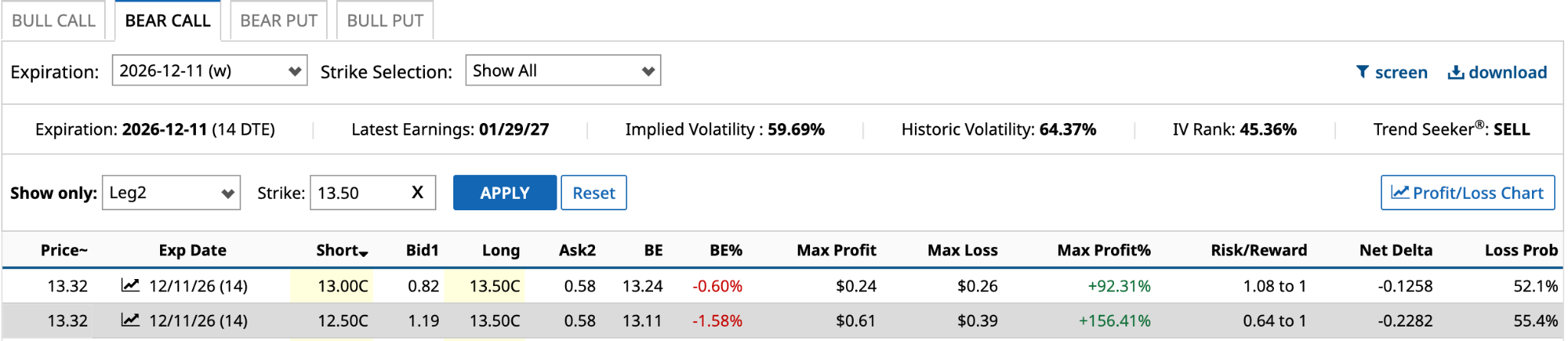
The trade makes money below the $13.11 breakeven to the $12.50 strike price, where it realizes the maximum profit. The probability of making money on this bear call spread is 44.6%, 410 basis points less than the bull call spread. However, if you’re more interested in generating income with less risk, the risk/reward proposition is much better.
Double Bull Spread
The Double Bull Spread combines a bull call spread with a bull put spread. This is a bullish options strategy when you believe SOFI’s share price will increase. In this case, I’ll use one of the three call strikes expiring next Friday for the bull call spread, combined with two appropriate put options.
Ideally, you want the cost of the bull call spread to be mostly covered by the premium received on the bull put spread. You also want the call strike prices above the current share price and the put strike prices below it. Lastly, the difference between the put strike prices should match the difference between the call strike prices.

The cost of buying the $13.50 call is $0.39 per share (ask), offset by $0.17 per share (bid) in premium from selling the $14 call, for a net debit of $0.22 per share. It’s shown above.
I’ll now look for put options that deliver a net credit around $0.22 per share and have a strike differential of $0.50 per share.

The bull put spread shown above involves selling the $14 put for $0.73 per share (bid price) and buying the $13.50 put for $0.46 per share for a net credit of $0.27 per share, which is reasonably close. Both vertical spreads have profit probabilities around 37.5%.
The double bull spread’s maximum profit would occur if SOFI’s share price is above the $14 call strike price next Friday. The maximum profit would be $0.55 per share [$14 strike price - $13.50 strike price + $0.05 net premium received]. The maximum loss would occur if the share price next Friday is below the $13.50 put strike price. The maximum loss would be $0.45 per share [$14 strike price - $13.50 strike price - $0.05 net premium received].
As with the long/short gut strangle, the double bull spread isn’t for everyone.
On the date of publication, Will Ashworth did not directly have a position in any of the securities mentioned in this article. All information and data in this article is solely for informational purposes. For more information please view the Barchart Disclosure Policy here.