
Earnings Beat Might Change The Case For Investing In Dow (DOW)
- Dow reported stronger Q3 2026 profit and margins, highlighted progress on cost reduction programs, and announced further development of nuclear power projects to support future energy needs.
- Management is leaning more into self help by using cost cuts and energy transition projects to reshape Dow’s earnings mix toward more resilient end markets.
- We will now see how Dow’s investment narrative could shift as cost savings ramp up alongside its advancing nuclear power plans.
Scan beyond Dow and compare its self help story with other chemical producers and industrials pursuing energy transition projects by reviewing the hand picked 17 nuclear energy infrastructure stocks.
Dow Investment Narrative Recap
To own Dow, you need to believe management can turn cost cuts, mix shift and energy projects into steadier earnings despite a choppy chemicals cycle. The recent Q3 2026 beat helps that story because it shows the cost program and margin work are landing in the income statement, not just in presentations.
In the near term, the key swing factor is still execution on self help and large projects, set against a backdrop of softer polyethylene demand and elevated energy and feedstock costs flagged in the analyst consensus Narrative on Simply Wall St. Margin pressure and litigation exposure remain the biggest operational risks if profitability or cash generation stalls.
The push into nuclear backed energy supply is the most interesting recent announcement linked to this update. Dow is tying its long term power needs to projects that aim to provide more predictable, lower carbon energy, which matters for a business that is heavily exposed to energy and feedstock pricing in every segment.
If these nuclear initiatives reach meaningful scale alongside the Alberta polyethylene build and silicones repositioning, investors get a clearer catalyst stack around structural cost and mix changes rather than relying on a demand upswing. Execution risk is high, especially with a large capital program, ongoing interest coverage constraints and dividends and debt service competing for the same cash flows.
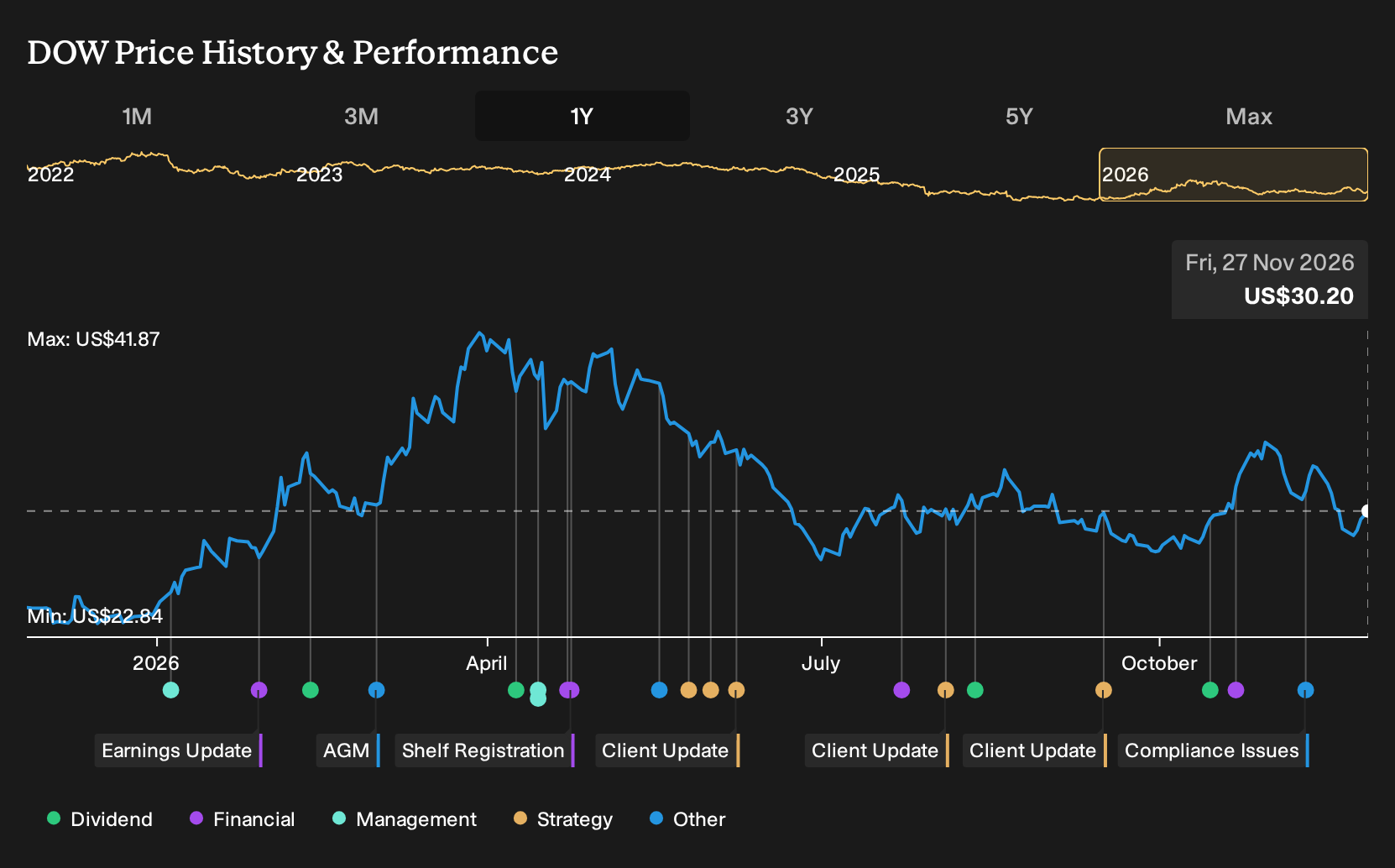
Analysts currently model Dow reaching US$46.4b in revenue and US$2.1b in earnings by 2029. This aligns with a 2.9% yearly revenue growth rate and an earnings change of about US$3b from today’s reported loss of US$905.0m to the 2029 consensus profit.
Uncover how Dow's fair value indicates a 15% potential upside to its current price, which could narrow quickly if sentiment around Dow improves.
Exploring Other Perspectives
Some of the lowest ranked analysts focus on Dow’s chlorpyrifos litigation as the swing factor rather than its nuclear energy push. Before this Q3 update, that cautious group was penciling in revenue of about US$40.6b by 2029 with earnings near US$2.1b, so their narrative is much more restrained. Views clearly differ, so it can help to explore several forecast paths instead of relying only on the upbeat consensus.
Explore 4 other Dow fair value estimates, including one that suggests it could be worth just $29.00.
Decide For Yourself
Don't just follow the ticker. Dig into the data and build a conviction that's truly your own.
- A great starting point for your Dow research is our analysis highlighting 3 key rewards and 2 important warning signs that could impact your investment decision.
- See our latest analysis for Dow. The report includes a comprehensive fundamental analysis summarized in a single visual, the Snowflake, making it easy to evaluate Dow's overall financial health at a glance.
Looking For More Ideas Beyond Dow?
If this update has sharpened your view on Dow but you want a broader watchlist, the Simply Wall St Screener can help you stress test your thesis against other companies with different risk and return profiles.
- If you care about valuation support and quality together, scan for companies that combine strong fundamentals with attractive prices using the 32 high quality undervalued stocks.
- For investors who want income to play a bigger role in total return, check out a curated set of high yield opportunities through the 39 dividend fortresses.
- When capital preservation and balance sheet resilience matter most to you, focus your search with the 31 resilient stocks with low risk scores.
Have feedback on this article? Concerned about the content? Get in touch with us directly. Alternatively, email editorial-team@simplywallst.com