
Is JP Morgan Chase & Company Stock Underperforming the S&P 500?
JPMorgan Chase & Co. (JPM) is a leading global financial services company headquartered in New York City. JPMorgan Chase provides a broad range of financial services, including consumer and community banking, commercial banking, investment banking, asset management, and payments and securities services. Its market cap stands at $857.7 billion, making it one of the largest publicly traded financial institutions in the world.
Companies valued at $200 billion or more are typically categorized as “mega-cap stocks,” and JPMorgan easily qualifies, with a market cap well above that mark, highlighting its massive scale and influence across the global financial system. Through its diversified businesses, leading investment-banking franchise, extensive U.S. consumer banking network, asset-management operations, and payments platform, JPMorgan continues to reinforce its position as one of the world’s most important financial institutions.
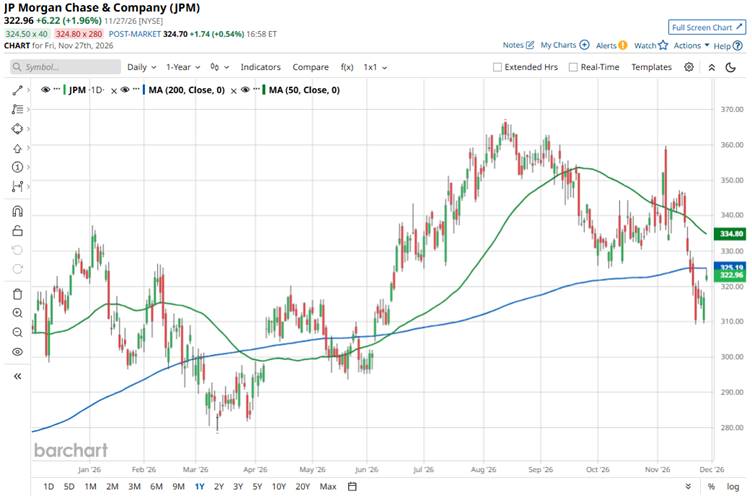
JPMorgan is down 11.9% from its 52-week high of $366.50, reached on Aug. 13. Over the past three months, JPM stock declined 8.8%, underperforming the S&P 500 Index’s ($SPX) 5.6% decline over the same period.
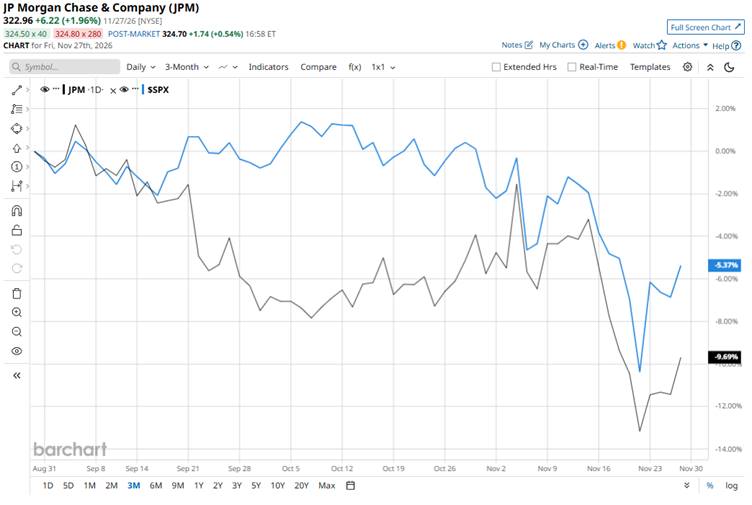
Over the longer term, shares of JPMorgan gained just marginally on a YTD basis and climbed 5% over the past 52 weeks, underperforming the S&P 500’s 6.6% YTD gain and 7.1% return over the past year.
The stock has traded above the 200-day moving average since early June but has dropped below the line lately. It is also currently trading well below the 50-day moving average.
JPMorgan’s stock has faced pressure despite continued revenue and earnings growth, as investors became concerned about slowing investment-banking and fixed-income trading activity, elevated expenses and weaker-than-expected quarterly results. In Q3 2026, revenue increased 8% YOY to $50.2 billion and net income rose 6% to $15.3 billion, but earnings of $5.57 per share missed Wall Street expectations.
Investment-banking fees rose 14% YOY but declined 8% sequentially, while fixed-income markets revenue fell 4% as client activity moderated amid interest-rate uncertainty, geopolitical tensions and elevated energy prices. The bank subsequently raised its 2026 expense outlook to $108.6 billion, adding to concerns about cost pressures and weighing on the stock.
For comparison, Bank of America Corporation (BAC) stock saw a 10.8% decline on a YTD basis and a 7.4% slump over the past 52 weeks.
The stock has a consensus “Moderate Buy” rating from 27 analysts covering it. The average price target of $369.04 implies 14.3% upside from the last closing price.
On the date of publication, Subhasree Kar did not directly have a position in any of the securities mentioned in this article. All information and data in this article is solely for informational purposes. For more information please view the Barchart Disclosure Policy here.