
Is Rykadan Capital (HKG:2288) Using Debt Sensibly?
Howard Marks put it nicely when he said that, rather than worrying about share price volatility, 'The possibility of permanent loss is the risk I worry about... and every practical investor I know worries about.' So it might be obvious that you need to consider debt, when you think about how risky any given stock is, because too much debt can sink a company. As with many other companies Rykadan Capital Limited (HKG:2288) makes use of debt. But should shareholders be worried about its use of debt?
When Is Debt Dangerous?
Debt assists a business until the business has trouble paying it off, either with new capital or with free cash flow. Part and parcel of capitalism is the process of 'creative destruction' where failed businesses are mercilessly liquidated by their bankers. While that is not too common, we often do see indebted companies permanently diluting shareholders because lenders force them to raise capital at a distressed price. By replacing dilution, though, debt can be an extremely good tool for businesses that need capital to invest in growth at high rates of return. The first thing to do when considering how much debt a business uses is to look at its cash and debt together.
How Much Debt Does Rykadan Capital Carry?
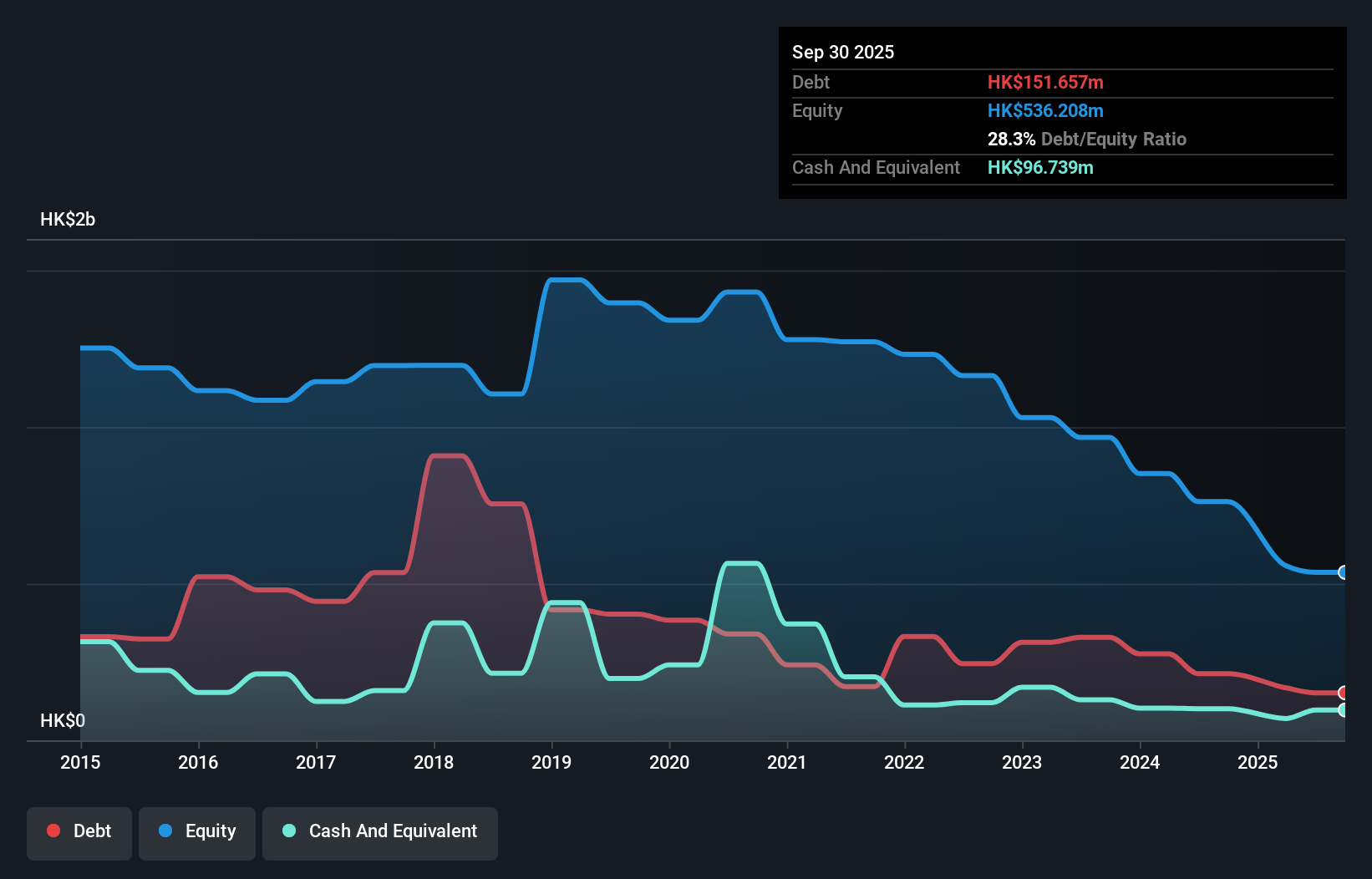
As you can see below, Rykadan Capital had HK$151.7m of debt at September 2025, down from HK$213.0m a year prior. However, it also had HK$96.7m in cash, and so its net debt is HK$54.9m.
A Look At Rykadan Capital's Liabilities
We can see from the most recent balance sheet that Rykadan Capital had liabilities of HK$81.4m falling due within a year, and liabilities of HK$91.9m due beyond that. Offsetting this, it had HK$96.7m in cash and HK$14.1m in receivables that were due within 12 months. So its liabilities total HK$62.4m more than the combination of its cash and short-term receivables.
Given this deficit is actually higher than the company's market capitalization of HK$60.4m, we think shareholders really should watch Rykadan Capital's debt levels, like a parent watching their child ride a bike for the first time. Hypothetically, extremely heavy dilution would be required if the company were forced to pay down its liabilities by raising capital at the current share price. The balance sheet is clearly the area to focus on when you are analysing debt. But it is Rykadan Capital's earnings that will influence how the balance sheet holds up in the future. So if you're keen to discover more about its earnings, it might be worth checking out this graph of its long term earnings trend.
See our latest analysis for Rykadan Capital
In the last year Rykadan Capital had a loss before interest and tax, and actually shrunk its revenue by 70%, to HK$52m. That makes us nervous, to say the least.
Caveat Emptor
While Rykadan Capital's falling revenue is about as heartwarming as a wet blanket, arguably its earnings before interest and tax (EBIT) loss is even less appealing. Its EBIT loss was a whopping HK$85m. Considering that alongside the liabilities mentioned above make us nervous about the company. It would need to improve its operations quickly for us to be interested in it. It's fair to say the loss of HK$265m didn't encourage us either; we'd like to see a profit. In the meantime, we consider the stock to be risky. The balance sheet is clearly the area to focus on when you are analysing debt. However, not all investment risk resides within the balance sheet - far from it. We've identified 3 warning signs with Rykadan Capital (at least 2 which shouldn't be ignored) , and understanding them should be part of your investment process.
If, after all that, you're more interested in a fast growing company with a rock-solid balance sheet, then check out our list of net cash growth stocks without delay.
Have feedback on this article? Concerned about the content? Get in touch with us directly. Alternatively, email editorial-team (at) simplywallst.com.
This article by Simply Wall St is general in nature. We provide commentary based on historical data and analyst forecasts only using an unbiased methodology and our articles are not intended to be financial advice. It does not constitute a recommendation to buy or sell any stock, and does not take account of your objectives, or your financial situation. We aim to bring you long-term focused analysis driven by fundamental data. Note that our analysis may not factor in the latest price-sensitive company announcements or qualitative material. Simply Wall St has no position in any stocks mentioned.