
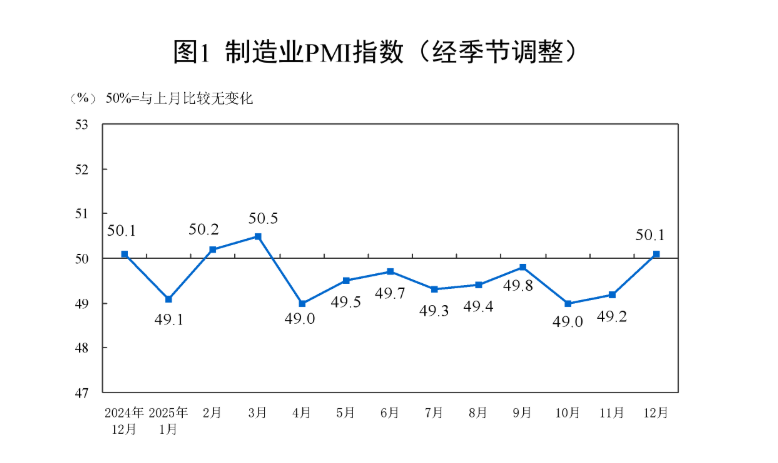
National Bureau of Statistics: The manufacturing PMI for December was 50.1%, up 0.9 percentage points from the previous month
The Zhitong Finance App learned that on December 31, data from the National Bureau of Statistics showed that in December, the manufacturing purchasing managers' index (PMI) was 50.1%, up 0.9 percentage points from the previous month, to an expansion range. Looking at the classification index, among the five classification indices that make up the manufacturing PMI, the production index, the new order index, and the supplier delivery time index are all above the critical point, and the raw material inventory index and the employee index are all below the critical point. In December, the non-manufacturing business activity index was 50.2%, up 0.7 percentage points from the previous month, returning to the expansion range. In December, the composite PMI output index was 50.7%, up 1.0 percentage point from the previous month, indicating the overall expansion of production and operation activities of Chinese enterprises compared to the previous month.
The original text is as follows:
Performance of China's Purchasing Managers' Index in December 2025
I. Operation of the China Manufacturing Purchasing Managers' Index
In December, the manufacturing purchasing managers' index (PMI) was 50.1%, up 0.9 percentage points from the previous month, to an expansion range.
In terms of enterprise size, the PMI for large enterprises was 50.8%, up 1.5 percentage points from the previous month, above the critical point; the PMI for medium-sized enterprises was 49.8%, up 0.9 percentage points from the previous month, still below the critical point; and the PMI for small enterprises was 48.6%, down 0.5 percentage points from the previous month, below the critical point.
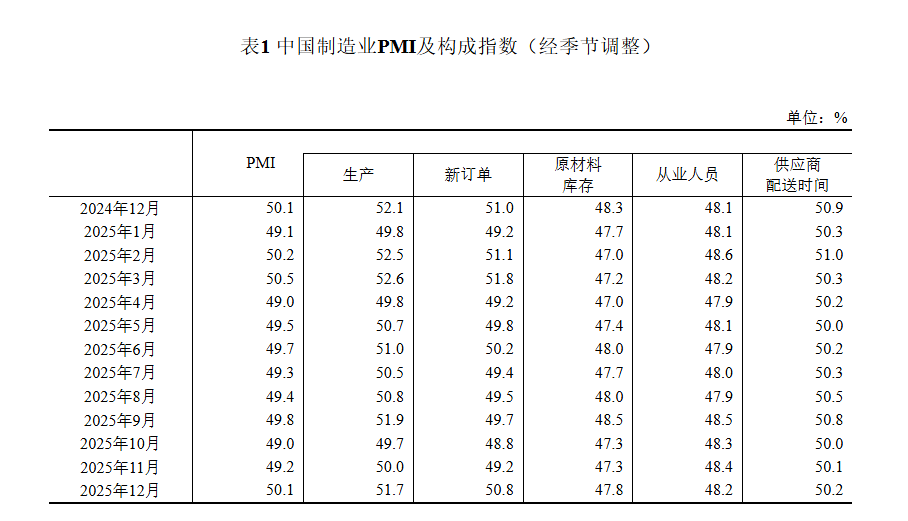
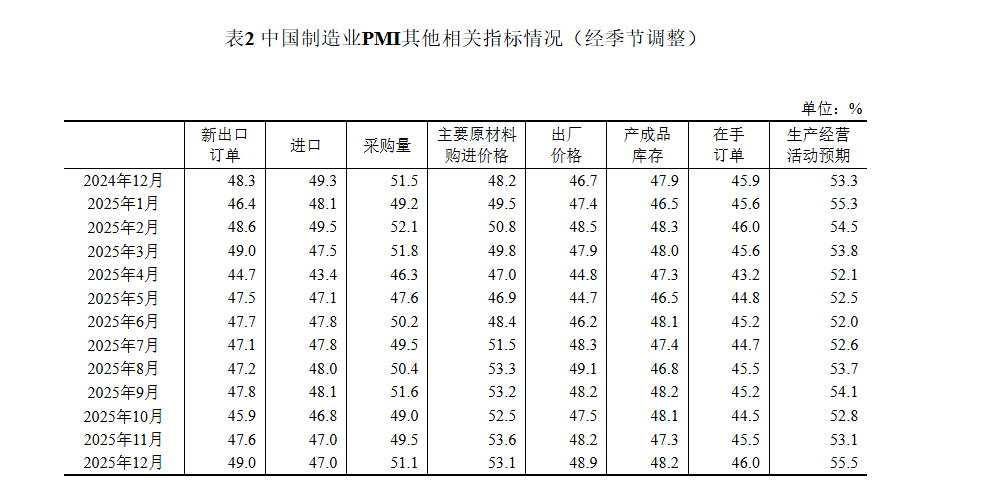
Looking at the classification index, among the five classification indices that make up the manufacturing PMI, the production index, the new order index, and the supplier delivery time index are all above the critical point, and the raw material inventory index and the employee index are all below the critical point.
The production index was 51.7%, up 1.7 percentage points from the previous month, indicating the acceleration of production activities of manufacturing enterprises.
The new orders index was 50.8%, up 1.6 percentage points from the previous month, indicating an improvement in demand in the manufacturing market.
The raw material inventory index was 47.8%, up 0.5 percentage points from the previous month, indicating that the decline in stocks of major raw materials in the manufacturing industry has narrowed.
The employee index was 48.2%, down 0.2 percentage points from the previous month, indicating a slight decline in employment sentiment in manufacturing enterprises.
The supplier delivery time index was 50.2%, up 0.1 percentage points from the previous month, indicating that the delivery time of raw material suppliers in the manufacturing industry continues to accelerate.
II. Operation of China's Non-Manufacturing Purchasing Managers' Index
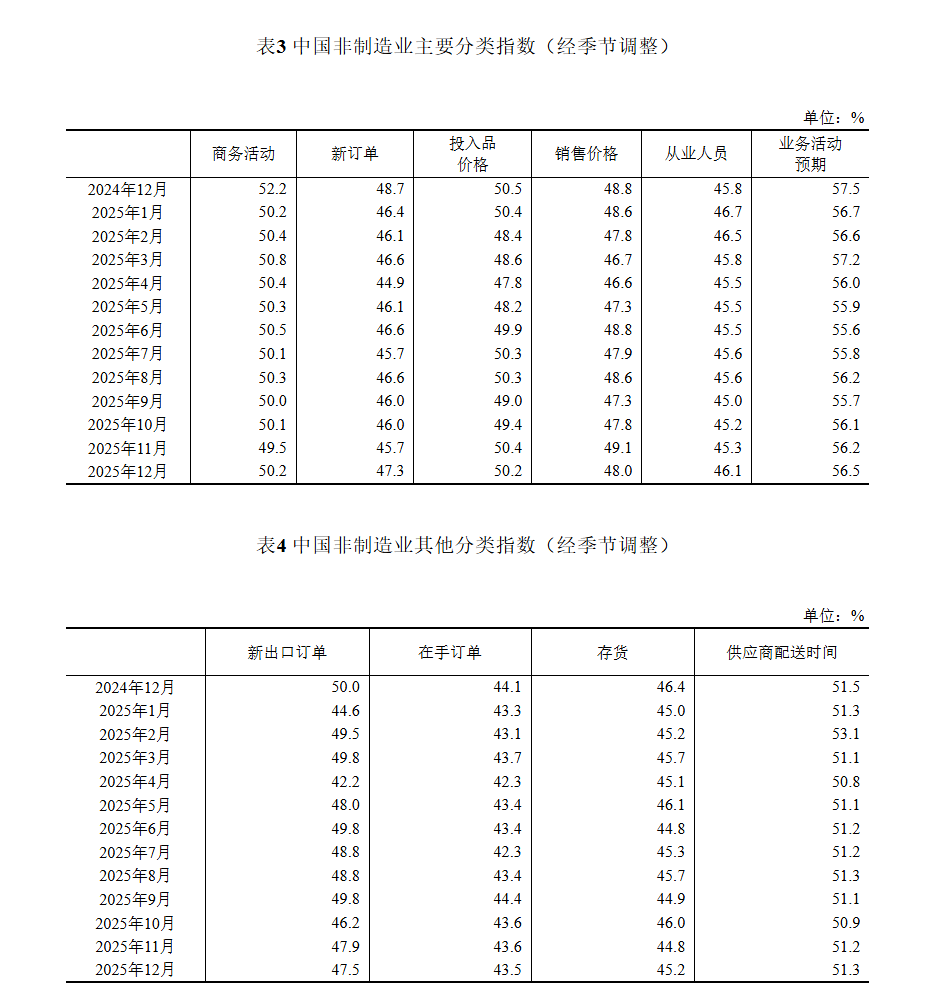
In December, the non-manufacturing business activity index was 50.2%, up 0.7 percentage points from the previous month, returning to the expansion range.
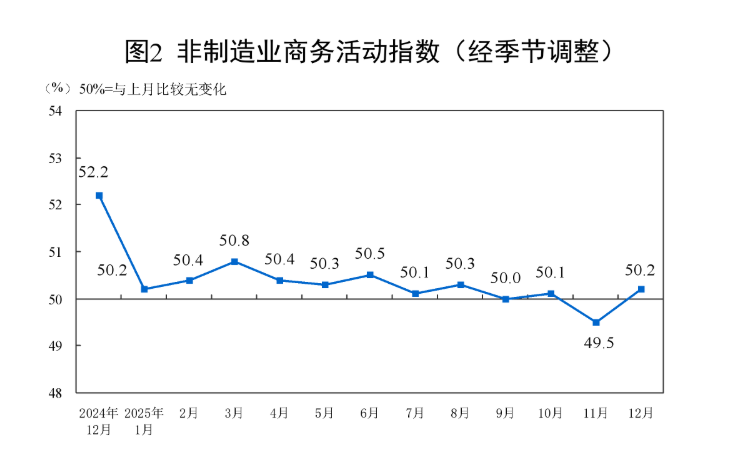
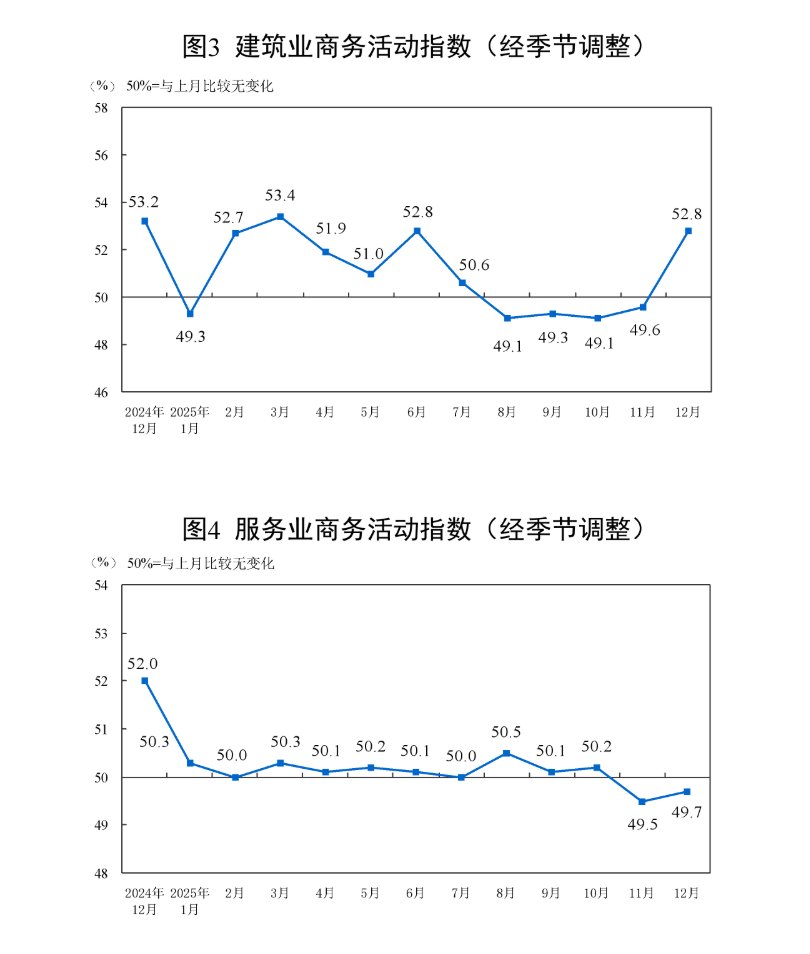
By industry, the index of business activity in the construction industry was 52.8%, up 3.2 percentage points from the previous month; the index of business activity in the service sector was 49.7%, up 0.2 percentage points from the previous month. Looking at the service industry, the indices of business activity in industries such as telecommunications, radio and television, and satellite transmission services, monetary and financial services, and capital market services are all in the high boom range of 60.0% or more; the indices of business activity in retail, catering and other industries are all below the critical point.
The new orders index was 47.3%, up 1.6 percentage points from the previous month, indicating a recovery in demand in the non-manufacturing market. By industry, the index of new orders in the construction industry was 47.4%, up 1.3 percentage points from the previous month; the index of new orders in the service sector was 47.3%, up 1.7 percentage points from the previous month.
The input price index was 50.2%, down 0.2 percentage points from the previous month, and still above the critical point, indicating that the overall level of input prices used by non-manufacturing enterprises for business activities has risen. By industry, the construction industry input price index was 50.8%, up 1.1 percentage points from the previous month; the service industry input price index was 50.1%, down 0.4 percentage points from the previous month.
The sales price index was 48.0%, down 1.1 percentage points from the previous month, indicating a decline in the overall level of non-manufacturing sales prices. By industry, the sales price index for the construction industry was 47.4%, down 1.0 percentage point from the previous month; the sales price index for the service industry was 48.1%, down 1.1 percentage points from the previous month.
The employee index was 46.1%, up 0.8 percentage points from the previous month, indicating a recovery in the employment sentiment of non-manufacturing enterprises. By industry, the index of workers in the construction industry was 41.0%, down 0.8 percentage points from the previous month; the index of workers in the service sector was 47.0%, up 1.1 percentage points from the previous month.
The expected business activity index was 56.5%, up 0.3 percentage points from the previous month, indicating that the overall confidence of non-manufacturing enterprises in market development continues to grow. By industry, the expected index of business activity in the construction industry was 57.4%, down 0.5 percentage points from the previous month; the expected index of business activity in the service sector was 56.4%, up 0.5 percentage points from the previous month.
III. Operation of China's Composite PMI Output Index
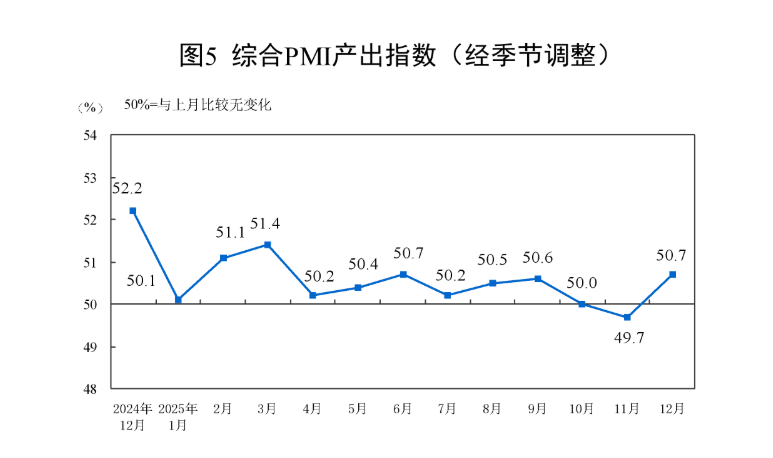
In December, the composite PMI output index was 50.7%, up 1.0 percentage point from the previous month, indicating the overall expansion of production and operation activities of Chinese enterprises compared to the previous month.
This article was compiled from the official website of the “National Bureau of Statistics”. Zhitong Finance Editor: Jiang Yuanhua.