
Hong Kong stocks took first place in the world in the 2025 IPO fundraising list, and the pharmaceutical sector became the “backbone”?
After 3 years of deep correction, the Hong Kong stock innovative drug market returned to a bull market in 2025 under the huge BD catalyzed by Sansheng Pharmaceuticals and Pfizer of 4.8 billion US dollars in May. The Hang Seng Healthcare Index (800804) went all the way up until September. The index reached a high of 4721.41 points, an increase of 102.76%.
Inspired by the bullish market for innovative drugs, the Hong Kong stock market has shown remarkable appeal to biomedical companies, and has also become an important platform for industry companies to seek listing financing this year. According to statistics from the Zhitong Finance App, a total of 27 healthcare/biotechnology companies were successfully listed in Hong Kong during this year, and nearly 10 companies submitted prospectus in December. Furthermore, according to data from the Hong Kong Stock Exchange, there are still about 300 companies waiting in line, with big health companies accounting for 1/3 of them.
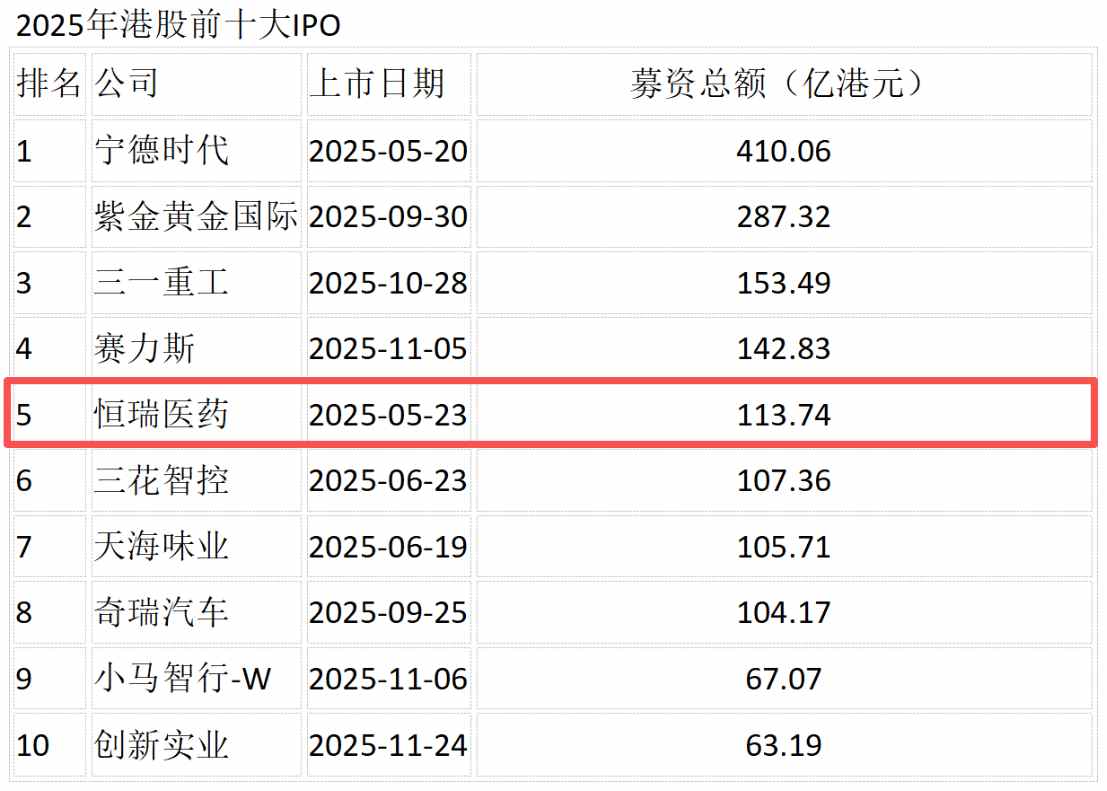
It is worth mentioning that, according to data from the Hong Kong Stock Exchange, the Hong Kong IPO market ranked first in the world in 2025, and the total amount of capital raised exceeded HK$280 billion. Not only was the amount raised nearly three times the amount raised last year, it also hit a new high in the last four years. Among them, Hengrui Pharmaceutical (01276) ranked in the top five Hong Kong stock IPOs raised in 2025 with HK$11.374 billion.
Pharmaceutical IPO Market Inspired by a Bull Market for Innovative Drugs
Behind the successful listing of 27 healthcare companies during the year, the incentives brought by the Hong Kong stock market for innovative drugs cannot be ignored.
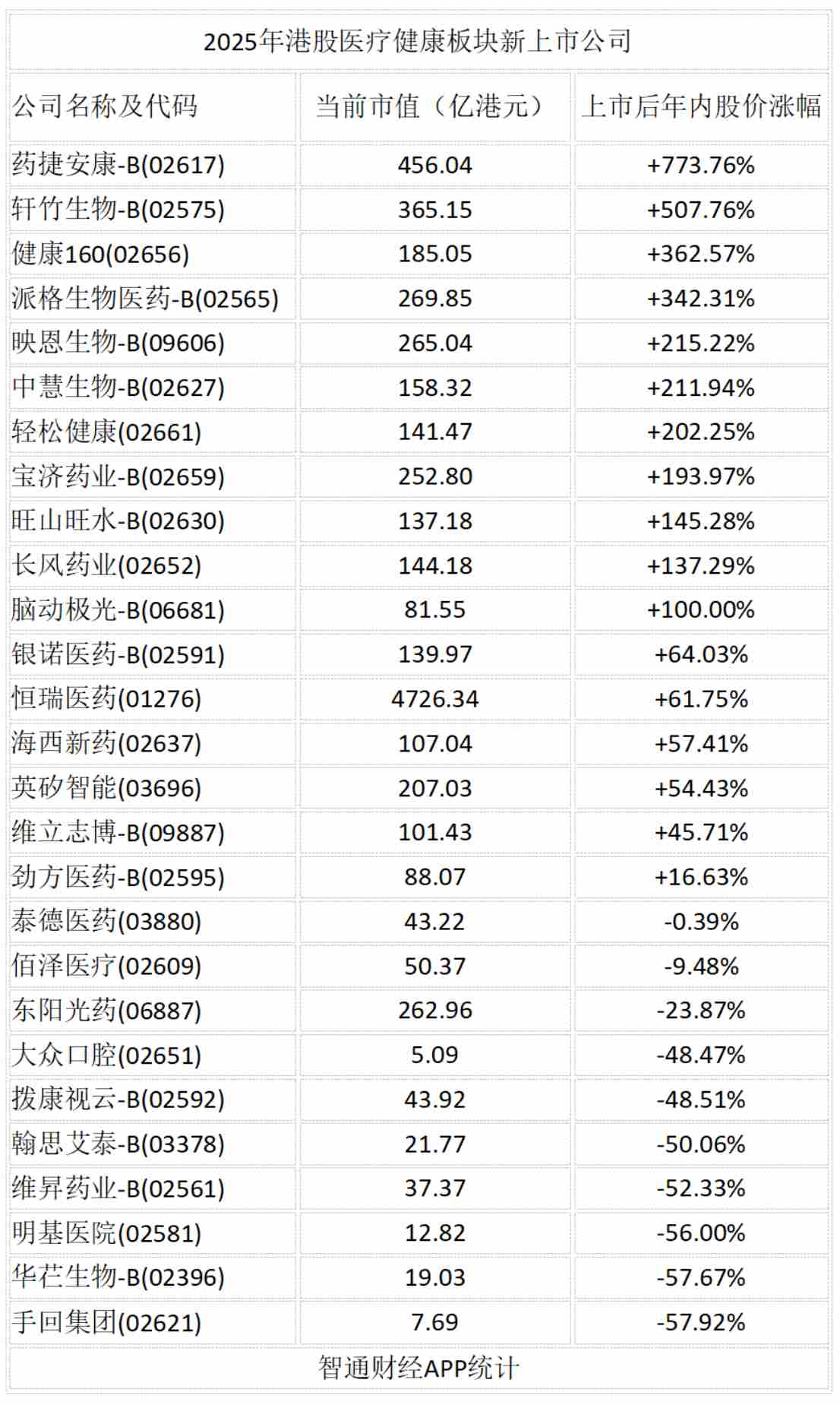
As mentioned above, the BD deal between Sansheng Pharmaceuticals (01530) and Pfizer in May of this year gave strength to the Hong Kong stock sector and kicked off a strong rebound in the Hong Kong stock pharmaceutical sector this year. With an increase of more than 100% compared to the beginning of the year, the Hang Seng Healthcare Index outperformed the Hang Seng Index, which significantly outperformed the Hang Seng Index, and became the most explosive segment of the Hong Kong market at the time.
However, the root cause of the high popularity of the Hong Kong stock pharmaceutical sector lies in the recovery of valuations reflected by the industry in the secondary market under policy dividends and incentives for innovative breakthroughs.
From a policy perspective, this year is undoubtedly a key turning point for the Chinese pharmaceutical industry from “innovation and awakening” to “value realization.” The important support for pharmaceuticals to reverse valuation in the secondary market is that the domestic pharmaceutical research and development policy system has achieved a breakthrough upgrade on the basis of ten years of reform and accumulation.
According to the Zhitong Finance App, the 2025 domestic pharmaceutical research and development policy is centered on “full chain support for innovation and multi-level guarantee value”, forming the three main policy lines of R&D guidance, payment guarantee, and internationalization support. In particular, on the R&D side and payment side, the domestic policy changed from “general support” to “precise innovation guidance”, and built a “dual-track parallel” system on the payment side to break the bottleneck of innovative drug payment, which greatly stimulated the domestic innovative drug market and greatly raised the second-level market's expectations for growth in the pharmaceutical sector, especially the innovative drug sector.
Take the performance of the 18A Hong Kong stock market as an example. During this year, the stock prices of 18A unprofitable biotech companies represented by Beihai Kangcheng-B (01228) rebounded sharply. Judging from the IPO results, biomedical companies that landed in Hong Kong stocks in 2025 were mainly innovative pharmaceutical companies, and most of them were in the unprofitable stage. Its technical route focuses on cutting-edge fields such as antibody-conjugated drugs (ADC), double antibodies, micronucleic acids, diet pills, and AI medicine.
Take Yingen Bio-B (09606), which focuses on ADC drug development, as an example. When it was launched in April this year, it had the largest financing scale for an 18A company since 2022, while Yinnuo Pharmaceutical-B (02591), which is dedicated to the development of GLP-1 drugs, was oversubscribed by more than 5,300 times when it went public sale in August this year. Both of these aspects demonstrate the market's long-term confidence in the innovative pharmaceutical industry.
Market trading is active, and pharmaceutical configurations are more cost-effective
In fact, one of the reasons why the healthcare sector, led by innovative drugs, performed well in 2025 is also due to the strong performance of the overall Hong Kong stock market this year. Against the backdrop of a significant increase in market trading activity, the healthcare sector showed a better configuration and cost ratio compared to other sectors.
According to the Zhitong Finance App, trading in the Hong Kong stock market has been active since this year. According to data disclosed by the Hong Kong Stock Exchange, as of the end of November this year, the total market value of the Hong Kong stock market was HK$48 trillion, an increase of 41% over the same period last year (HK$34 trillion). The average daily turnover for the first 11 months of 2025 was HK$255.8 billion, an increase of 95% over the same period last year (HK$13.9 billion), and the liquidity of Hong Kong stocks improved markedly.
Meanwhile, southbound capital became an important incremental capital for the Hong Kong stock market during this period. According to Wind data, as of December 30, the total net purchases of southbound capital during the year reached HK$1.40 trillion, making it the most important liquidity support for the Hong Kong stock market.
And the southbound capital clearly sees the pharmaceutical sector as an important direction of allocation. On the one hand, the valuation of the Hong Kong stock pharmaceutical sector was once only about 15 times PE after a deep correction, forming a clear value depression. There is strong demand for valuation repair. In a situation where expectations of the Fed's interest rate cuts are heating up and global liquidity is relaxed, the additional value of the Hong Kong stock pharmaceutical sector is obvious.
On the other hand, the performance of IPOs in the pharmaceutical sector of Hong Kong stocks was significantly superior to the overall market performance of IPOs, which is also an important reason for choosing to allocate incremental capital. The data shows that as of December 30, Hong Kong stocks completed the listing of 117 IPOs during the year, an increase of 67.14% over the previous year. Meanwhile, on August 4 this year, the Hong Kong Stock Exchange officially implemented the new rules on the IPO allocation mechanism. Companies to be listed can choose between “Mechanism A” and “Mechanism B”, further improving the efficiency of IPO pricing, enhancing market stability, and giving issuers and institutional investors greater voice, and forming an issuance pattern centered on institutions, cornerstones, and anchored shares to achieve the goal of “insurance protection” for the company's listing.
This policy is reflected most clearly in the IPO market, where the breakout rate of new shares has declined significantly. The Zhitong Finance App learned that from 2022 to 2024, the Hong Kong stock IPO breakout rate remained stable at 32%-34%, but in 2025, with more IPOs, this ratio dropped to 28.83%.
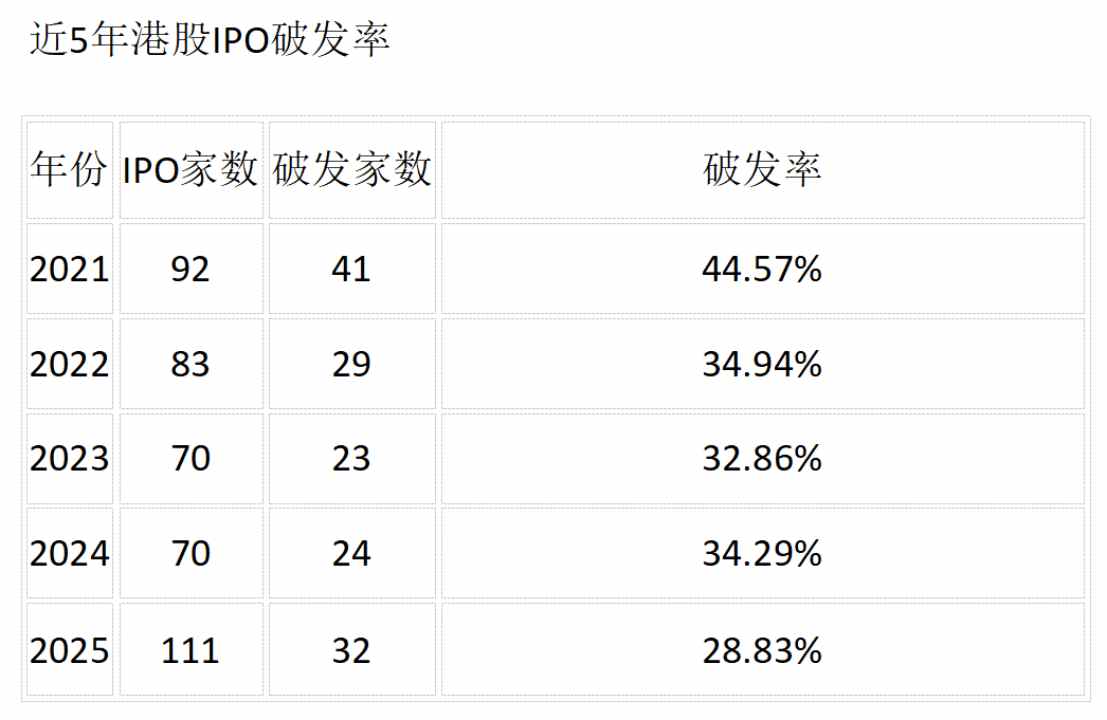
Even so, the breakout rate of Hong Kong healthcare IPOs driven by the bullish market for innovative drugs is still down to about 17%, which is significantly lower than the overall market average. Among them, individual stocks that rose more than 100% on the first day accounted for more than 35%, while Yinnuo Pharmaceutical also set an annual record for the increase in IPOs with a 206% first-day increase, showing a high allocation cost performance ratio.
However, the boom in market investment in healthcare companies did not continue throughout the year. Market sentiment quietly changed in December. This was reflected in the sharp break in IPOs of three healthcare companies in December and the emergence of a “big bull stock.”
In December of this year, BenQ Hospital (02581) plummeted 49.46% on the first day, Hansi AT-B (03378) fell 46.25% on the first day, and Huayi Biotech (02396) fell 29.32% on the first day. What all three companies have in common is that the fundamentals need to be improved. It is worth mentioning that the latter two were both issued under Mechanism B during the IPO stage. Huayi Biotech's Hong Kong public sale portion was oversubscribed by 791.95 times, while Hansai also received a huge overpurchase of 3074.09 times. But even so, it still had its first breaking story.
Insili Intelligence (03696), which was also listed on the healthcare circuit since then, took the position of Biotech IPO, which raised the most amount of capital in Hong Kong stocks during the year, and achieved an undermarket closing increase of more than 50%, with the biggest increase of nearly 50% on the day of the first listing. In other words, although the current market still maintains a high level of enthusiasm for the Hong Kong stock pharmaceutical sector, investors are not “brainless all-in,” and companies with stronger fundamentals and more prospects for development have clearly become better allocation choices.