
Kyocera Corporation's (TSE:6971) Price In Tune With Earnings
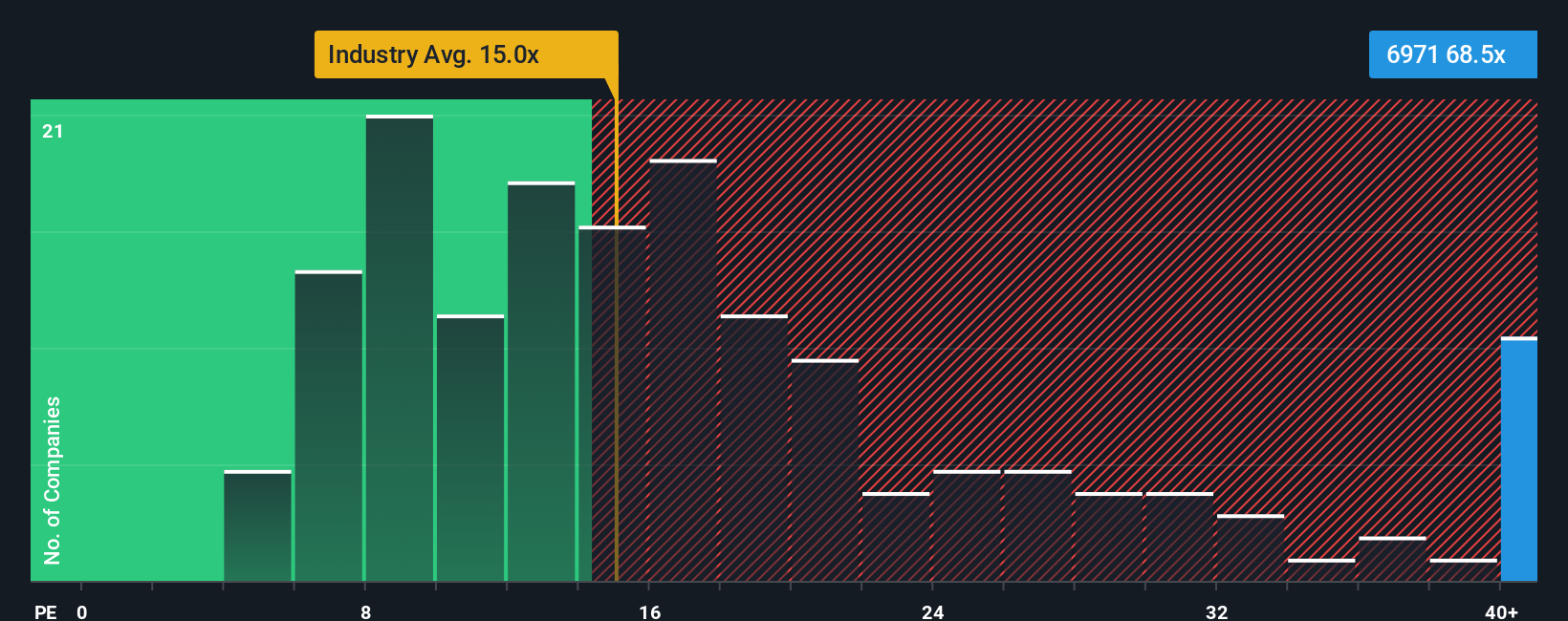
Kyocera Corporation's (TSE:6971) price-to-earnings (or "P/E") ratio of 68.5x might make it look like a strong sell right now compared to the market in Japan, where around half of the companies have P/E ratios below 14x and even P/E's below 10x are quite common. Although, it's not wise to just take the P/E at face value as there may be an explanation why it's so lofty.
While the market has experienced earnings growth lately, Kyocera's earnings have gone into reverse gear, which is not great. One possibility is that the P/E is high because investors think this poor earnings performance will turn the corner. You'd really hope so, otherwise you're paying a pretty hefty price for no particular reason.
See our latest analysis for Kyocera
How Is Kyocera's Growth Trending?
Kyocera's P/E ratio would be typical for a company that's expected to deliver very strong growth, and importantly, perform much better than the market.
Retrospectively, the last year delivered a frustrating 46% decrease to the company's bottom line. The last three years don't look nice either as the company has shrunk EPS by 69% in aggregate. So unfortunately, we have to acknowledge that the company has not done a great job of growing earnings over that time.
Looking ahead now, EPS is anticipated to climb by 47% per year during the coming three years according to the analysts following the company. With the market only predicted to deliver 9.0% per annum, the company is positioned for a stronger earnings result.
With this information, we can see why Kyocera is trading at such a high P/E compared to the market. It seems most investors are expecting this strong future growth and are willing to pay more for the stock.
The Bottom Line On Kyocera's P/E
We'd say the price-to-earnings ratio's power isn't primarily as a valuation instrument but rather to gauge current investor sentiment and future expectations.
As we suspected, our examination of Kyocera's analyst forecasts revealed that its superior earnings outlook is contributing to its high P/E. Right now shareholders are comfortable with the P/E as they are quite confident future earnings aren't under threat. Unless these conditions change, they will continue to provide strong support to the share price.
It's always necessary to consider the ever-present spectre of investment risk. We've identified 3 warning signs with Kyocera (at least 1 which shouldn't be ignored), and understanding these should be part of your investment process.
You might be able to find a better investment than Kyocera. If you want a selection of possible candidates, check out this free list of interesting companies that trade on a low P/E (but have proven they can grow earnings).
Have feedback on this article? Concerned about the content? Get in touch with us directly. Alternatively, email editorial-team (at) simplywallst.com.
This article by Simply Wall St is general in nature. We provide commentary based on historical data and analyst forecasts only using an unbiased methodology and our articles are not intended to be financial advice. It does not constitute a recommendation to buy or sell any stock, and does not take account of your objectives, or your financial situation. We aim to bring you long-term focused analysis driven by fundamental data. Note that our analysis may not factor in the latest price-sensitive company announcements or qualitative material. Simply Wall St has no position in any stocks mentioned.