
China Federation of Logistics and Purchasing: The global manufacturing PMI for December 2025 was 49.5%, a slight decrease of 0.1 percentage points from the previous month
The Zhitong Finance App learned that the China Federation of Logistics and Purchasing announced that the global manufacturing PMI for December 2025 was 49.5%, a slight decrease of 0.1 percentage points from the previous month, and operated within the 49%-50% range for 10 consecutive months. In 2025, the average global manufacturing PMI was 49.6%, up 0.3 percentage points from 2024. Looking at the subregion, the manufacturing PMI in Asia rose to more than 51% compared to the previous month; the European manufacturing PMI fell from the previous month and is still below 50%; the manufacturing PMI in Africa rose from the previous month, rising to more than 50%; and the American manufacturing PMI fell below 48% compared to the previous month. In 2025, the average manufacturing PMI level of each region was somewhat different from the 2024 trend. The average manufacturing PMI in Asia was 50.8%, slightly down 0.1 percentage points from 2024; the average manufacturing PMI in Africa was 50.2%, up 0.7 percentage points from 2024; the average manufacturing PMI in the US was 48.8%, the same as in 2024; and the average European manufacturing PMI was 48.8%, up 1.1 percentage points from 2024.
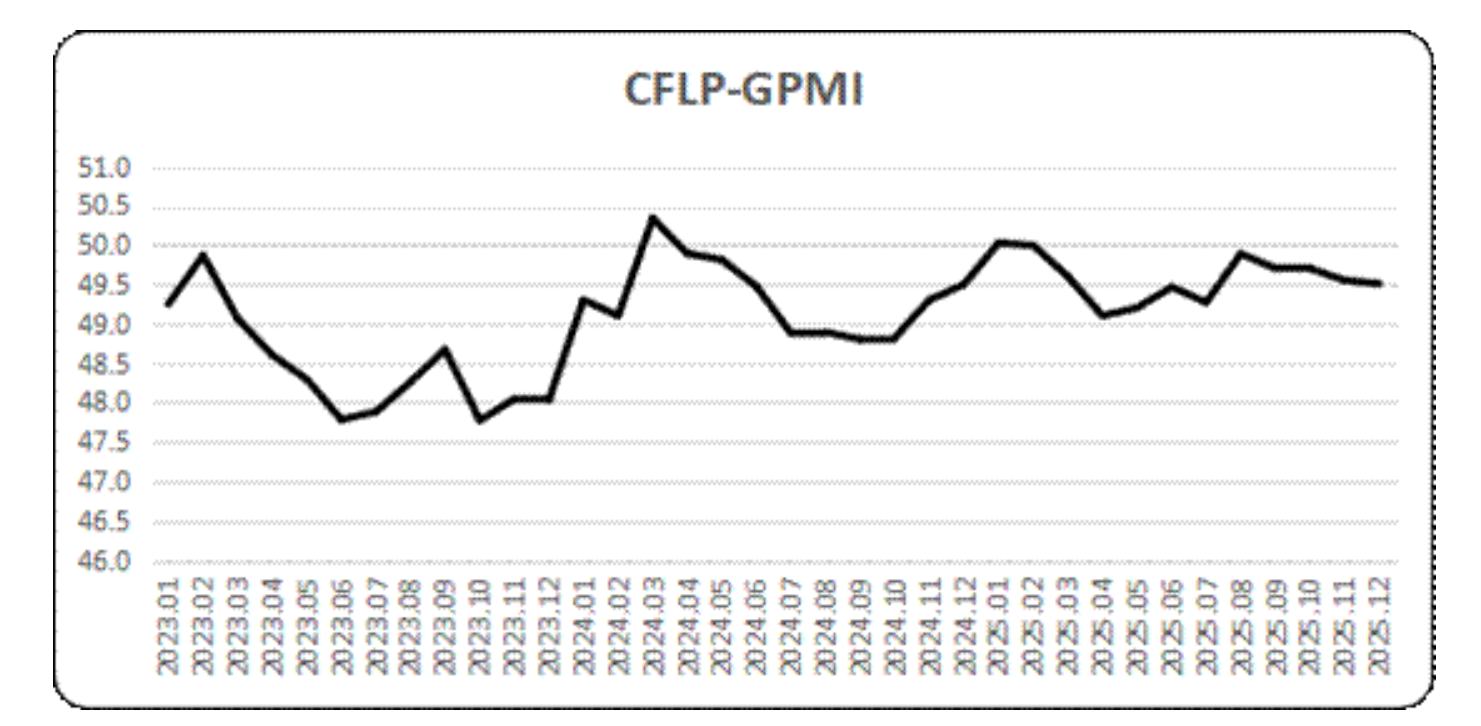
The composite index changed. The recovery momentum of the global manufacturing industry continued to slow slightly in December. The index remained stable in the 49% range, maintaining a weak recovery pattern, but the intensity of recovery has not yet formed effective support, and it still needs to be further consolidated and improved. Looking at the subregions, the Asian manufacturing industry is expanding at an accelerated pace, continuing to demonstrate a key supporting role in the global economy; the recovery of the African manufacturing industry has picked up; the European manufacturing industry has maintained a weak recovery trend, but the pace of recovery has weakened slightly; and the American manufacturing industry continues to decline weakly.
Judging from the performance for the full year of 2025, the overall recovery of the global manufacturing industry is slightly better than 2024, but the average index level is still below 50%, which means that the recovery trend of the global economy is still steady or weak under multiple shocks such as the influence of tariff policies and geopolitical conflicts, and the recovery still needs to be strengthened. Judging from the trends of each quarter, the recovery trend of the global manufacturing industry in the first quarter of 2024 was relatively stable, with an average PMI of 49.9%; affected by tariff policies in the second quarter, the recovery of the global manufacturing industry weakened, with an average PMI of 49.3%; there was a recovery in the third and fourth quarters, and the average PMI was 49.6%. Looking at the subregion, the recovery of the Asian manufacturing industry is still the strongest. Although the average index has declined slightly from 2024, it is still above 50%, which is an important support for the steady recovery of the global economy. The recovery of African manufacturing has increased, and the average index has risen to more than 50%. The decline in the European manufacturing industry has narrowed, but the recovery trend is still relatively weak, with an average index value below 49%; the recovery of the American manufacturing industry remained flat compared to 2024, continuing to maintain a weak recovery trend, and the average index value is still below 49%.
Looking ahead to 2026, the global economy may still face uncertainty and continue to maintain a weak recovery trend. Currently, major international economic institutions still generally predict that the growth rate of the world economy will slow down in 2026. The Organization for Economic Cooperation and Development (OECD) released its latest economic outlook report. The global economic growth rate is expected to be 3.2% and 2.9% in 2025 and 2026, respectively, in line with the forecast for September 2025. In 2026, international geopolitical conflicts will remain the core uncertain factor disrupting the recovery of the global economy. The continued spread of trade protectionism will further inhibit the vitality of international trade, and uncertainty about global trade trends will increase. According to the latest WTO forecast, the growth forecast for global trade in goods in 2026 was drastically lowered to 0.5%, and the growth rate of global services exports fell to 4.4%. At the same time, many countries around the world are still plagued by high debt and high deficits, which in turn continue to disrupt the stability of the global governance pattern.
However, it is also important to note that the current level of global inflation is generally showing a downward trend, and inflationary pressure is expected to ease further in 2026, reserving more room for policy adjustments in various countries. Meanwhile, the investment boom in the field of artificial intelligence is accelerating the formation of new growth momentum. It will not only provide incremental support for global economic growth, but will also promote iterative upgrading of the global industry and optimization of the economic structure, which will help hedge against downside risks and stabilize the basic market for global economic recovery. Facing a complex environment, countries around the world should speed up strategic adjustments, focus on structural reforms domestically, deepen regional collaboration externally, seek a dynamic balance between open cooperation and economic security, promote the application of AI technology standards and green transformation and inclusiveness, and build an inclusive and linked global economic governance system in order to break growth bottlenecks and achieve sustainable recovery.
The weak manufacturing industry in the US declined further, and PMI continued to decline
In December 2025, the American manufacturing PMI was 47.9%, down 0.4 percentage points from the previous month to less than 48%. It fell month-on-month for 3 consecutive months and fell below 50% for 10 consecutive months, indicating a further decline in the weak American manufacturing sector. According to data from major countries, in December, the manufacturing PMI of the US, Brazil, and Mexico all fell to varying degrees from the previous month, and the index was all below 48%; Canada's manufacturing PMI rose slightly from the previous month, but the index was still below 49%; the Colombian manufacturing PMI declined from the previous month, and the index was above 50%.
According to the ISM report, in December 2025, the US manufacturing PMI was 47.9%, down 0.3 percentage points from the previous month, falling for 5 consecutive months, falling below 50% for 10 consecutive months and hitting a new low in 2025, indicating that the overall downward trend of the US manufacturing industry has accelerated. The sub-index shows that the new orders index has risen, but it is still below 48%, and the demand-side decline has narrowed slightly but is still weakly operating; the production index has declined, the index level is 51%, which is still in the expansion range, and the growth rate has slowed slightly; the employee index has risen, still below 45%, and the downward trend has narrowed slightly, but remains weak; the purchase price index remains flat compared to the previous month and remains high above 58%, and the transmission pressure on the cost side of the tariff policy continues. In 2025, the average US manufacturing PMI was 48.9%, up 0.6 percentage points from 2024, indicating that the recovery momentum of the US manufacturing industry in 2025 improved slightly compared to 2024, but the average level was still below 49%, which means that the recovery of the US manufacturing industry is still relatively weak.
Looking ahead to 2026, Bank of America Global Research predicts that the US economy will maintain a mid-2% growth rate by the end of 2026. What is alarming is that the accumulation of downside risks still needs to be focused on. Multiple adverse factors, such as the impact of the US government shutdown, the weakness of the job market, and the continuous rise in commodity prices driven by tariff policies, continue to constrain US economic growth. Consumer confidence in the US has also declined further recently. In December 2025, the consumer confidence index fell further from 92.9 after the November revision to 89.1, falling for the fifth month in a row, the lowest level since April this year, indicating that residents' expectations for the economic outlook have weakened. In terms of inflation, the core US PCE price index rose to a high level of 2.9% in the third quarter. Inflationary pressure has not completely subsided. Combined with the slowdown in the labor market, the complexity of future decisions by the Federal Reserve has increased. The rebound in inflation may force the interest rate cut process to be delayed or reversed, which in turn has a ripple effect on the overall pace of economic recovery.
African manufacturing rebounded, and PMI rose to more than 50%
In December 2025, Africa's manufacturing PMI was 50.7%, up 1.3 percentage points from the previous month, and once again rose to more than 50%. Looking at major countries, the manufacturing PMI of Kenya and Nigeria fell from the previous month, but it is still at a high level of more than 53%; the manufacturing PMI of Egypt has declined from the previous month and is still above 50%.
According to changes in comprehensive data, the recovery of the African manufacturing industry has rebounded, and the index has once again risen to an expansion range, indicating that the basis for economic recovery in Africa has strengthened. The average African manufacturing PMI in 2025 will be higher than in 2024, and will rise to an expansion range of more than 50%, which means that the recovery of the African manufacturing industry will increase in 2025, and the overall operation will be steady and improving.
Looking ahead to 2026, the African economy still has a basis for positive recovery. According to the latest International Monetary Fund (IMF) forecast, Africa is poised to have the largest number of high-growth economies in the world in 2026, with a growth rate of at least 6%. As the integration of the African Free Trade Zone continues to deepen, cross-border infrastructure projects are progressing steadily, and the “Belt and Road” cooperation dividends will further smooth the regional economic cycle and inject momentum into industrialization transformation. However, it is worth noting that debt pressure on African countries is still quite prominent, and high debt repayment costs will seriously crowd out development funds. Meanwhile, the shortage of electricity in Africa continues to constrain industrial development. Furthermore, factors such as climate shocks and local political instability will also potentially disrupt Africa's economic recovery.
The European manufacturing industry is steadily weakening, and PMI has declined slightly
In December 2025, the European manufacturing PMI was 49.3%, down 0.3 percentage points from the previous month, and remained at 49% and above for 6 consecutive months. Looking at major countries, the manufacturing PMI of the UK, France, and Greece increased compared to the previous month, and was in the expansion range of more than 50%; the manufacturing PMI of Germany and Italy declined to varying degrees compared to the previous month, and both fell below 48%.
Overall data changes. Compared with last month, the European manufacturing industry as a whole has maintained a weak recovery trend, and the recovery rate has weakened slightly. At the same time, although the average European manufacturing PMI in 2025 was higher than in 2024, the average index is still in a weak boom range below 49%. The European economy is still facing many uncertainties within and outside the European economy, which may continue to inhibit the speed of its recovery. On the one hand, the ongoing development of the current geopolitical conflict and the uncertainty brought about by the tariff policies of the US and Europe continue to cause more disturbances in the external environment for European economic recovery. On the other hand, Europe is also facing many difficulties. Germany's economic outlook, which is the locomotive of the European economy, is facing great uncertainty. The IFO Institute for Economic Research, a German think tank, lowered Germany's 2026 economic growth forecast by 0.8% in December 2025, 0.5 percentage points lower than the fall forecast. France also continues to face problems such as rising debt, high deficits, and economic stagnation. The International Monetary Fund predicts that France's debt as a share of its GDP will rise from about 116% in 2025 to nearly 130% in 2030. In order to meet multiple challenges, the ECB's monetary policy meeting in December 2025 decided to keep the three key interest rates unchanged. The Eurozone CPI stabilized within a reasonable range of 2.1% during the same period, providing solid data support for the stability of interest rate policies.
Looking ahead to 2026, the European economy will continue to seek balance between resilience and pressure. Factors such as Germany's trillion-euro infrastructure and defense investment plan and Bulgaria's entry into the Eurozone are expected to inject growth momentum into the European economy, but risks such as potential escalation of trade frictions between the US and Europe, increased fiscal and debt pressure, fluctuations in energy prices, and delays in structural reforms will continue to disrupt. If the integration of the single market can be deepened, regulatory reforms promoted, and trade differences are properly managed, the European economy is expected to consolidate its moderate recovery trend and gradually increase the sustainability and endogenous momentum of growth.
The Asian manufacturing industry is expanding at an accelerated pace, and PMI has risen
In December 2025, Asia's manufacturing PMI was 51.1%, up 0.4 percentage points from the previous month, and was above 50% for 8 consecutive months. Looking at major countries, China's manufacturing PMI increased from the previous month, at more than 50%; India's manufacturing PMI fell from the previous month, at 55%; among ASEAN countries, the manufacturing PMI for Thailand was above 55%, and the manufacturing PMI for Malaysia, Singapore, Indonesia, the Philippines, and Myanmar were all above 50%; Japan and South Korea were both higher than the previous month. Japan is at the critical point of 50%, and South Korea is slightly above 50%.
According to changes in comprehensive data, the Asian manufacturing industry continues to expand, and the growth rate has accelerated, continuing to demonstrate a key supporting role in the global economy and injecting continuous and stable development impetus into global economic recovery. The Asian manufacturing industry continued to show a steady and good expansion trend in 2025. Although the average annual manufacturing PMI fell slightly from 2024, it was still above 50%. Looking ahead to 2026, the Asian economy will continue to unleash high-quality development momentum and growth vitality, and is still the core engine of global economic recovery. With the entry into force of the Regional Comprehensive Economic Partnership Agreement, dividends continue to be released, promoting the integration of regional industrial chains and further upgrading the level of trade facilitation. At the same time, China is still a stabilizer and ballast stone for the smooth operation of the Asian economy and the global economy. It is expected that in 2026, China's economic recovery will continue to consolidate its positive trend with active fiscal policies and flexible and moderate monetary policies. Recently, the International Monetary Fund (IMF) and the World Bank have raised their forecasts for China's economic growth rate in 2025. Among them, the IMF expects China's economy to grow by 5.0% and 4.5% in 2025 and 2026, respectively, up 0.2 and 0.3 percentage points from the October forecast. In the latest China Economic Briefing, the World Bank raised its forecast for China's economic growth rate in 2025 by 0.4 percentage points.
This article was edited by China Federation of Logistics and Purchasing, Zhitong Finance Editor: Chen Wenfang.