
4 Analysts Assess Mattel: What You Need To Know
Across the recent three months, 4 analysts have shared their insights on Mattel (NASDAQ:MAT), expressing a variety of opinions spanning from bullish to bearish.
The table below offers a condensed view of their recent ratings, showcasing the changing sentiments over the past 30 days and comparing them to the preceding months.
| Bullish | Somewhat Bullish | Indifferent | Somewhat Bearish | Bearish | |
|---|---|---|---|---|---|
| Total Ratings | 2 | 0 | 2 | 0 | 0 |
| Last 30D | 0 | 0 | 1 | 0 | 0 |
| 1M Ago | 1 | 0 | 0 | 0 | 0 |
| 2M Ago | 0 | 0 | 0 | 0 | 0 |
| 3M Ago | 1 | 0 | 1 | 0 | 0 |
Providing deeper insights, analysts have established 12-month price targets, indicating an average target of $24.75, along with a high estimate of $30.00 and a low estimate of $21.00. Observing a downward trend, the current average is 5.71% lower than the prior average price target of $26.25.
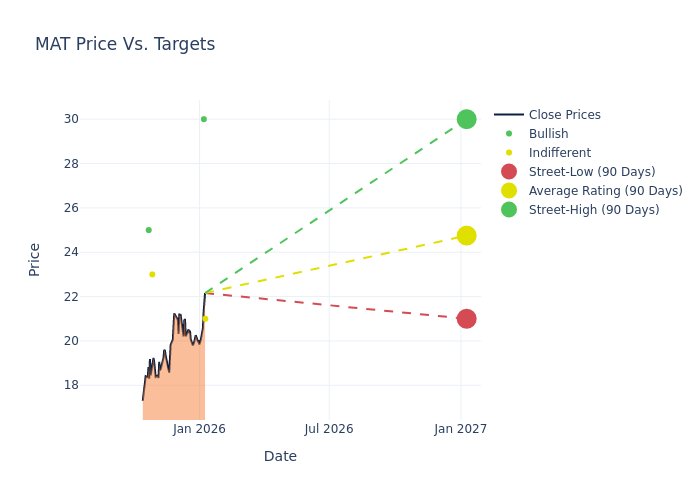
Investigating Analyst Ratings: An Elaborate Study
The standing of Mattel among financial experts is revealed through an in-depth exploration of recent analyst actions. The summary below outlines key analysts, their recent evaluations, and adjustments to ratings and price targets.
| Analyst | Analyst Firm | Action Taken | Rating | Current Price Target | Prior Price Target |
|---|---|---|---|---|---|
| Stephen Laszczyk | Goldman Sachs | Maintains | Neutral | $21.00 | $21.00 |
| Arpine Kocharyan | UBS | Raises | Buy | $30.00 | $29.00 |
| Christopher Horvers | JP Morgan | Lowers | Neutral | $23.00 | $25.00 |
| Michael Baker | DA Davidson | Lowers | Buy | $25.00 | $30.00 |
Key Insights:
- Action Taken: Analysts adapt their recommendations to changing market conditions and company performance. Whether they 'Maintain', 'Raise' or 'Lower' their stance, it reflects their response to recent developments related to Mattel. This information provides a snapshot of how analysts perceive the current state of the company.
- Rating: Offering insights into predictions, analysts assign qualitative values, from 'Outperform' to 'Underperform'. These ratings convey expectations for the relative performance of Mattel compared to the broader market.
- Price Targets: Analysts explore the dynamics of price targets, providing estimates for the future value of Mattel's stock. This examination reveals shifts in analysts' expectations over time.
Navigating through these analyst evaluations alongside other financial indicators can contribute to a holistic understanding of Mattel's market standing. Stay informed and make data-driven decisions with our Ratings Table.
Stay up to date on Mattel analyst ratings.
Unveiling the Story Behind Mattel
Mattel manufactures and markets toy products that are sold to its wholesale and direct to retail customers. The company offers products for children and families, including toys for infants and preschoolers, girls and boys, youth electronics, hand-held and other games, puzzles, educational toys, media-driven products, and plush and fashion-related toys. Mattel's owned portfolio includes Barbie, Hot Wheels, Fisher-Price, Thomas & Friends, and American Girl. In addition, it currently manufactures toy products for its segments both internally and externally (through manufacturing partners). Nearly 60% of its net sales were generated from North America in 2024, with the remainder stemming from international markets.
Financial Milestones: Mattel's Journey
Market Capitalization: Positioned above industry average, the company's market capitalization underscores its superiority in size, indicative of a strong market presence.
Revenue Challenges: Mattel's revenue growth over 3M faced difficulties. As of 30 September, 2025, the company experienced a decline of approximately -5.85%. This indicates a decrease in top-line earnings. When compared to others in the Consumer Discretionary sector, the company faces challenges, achieving a growth rate lower than the average among peers.
Net Margin: Mattel's net margin is below industry standards, pointing towards difficulties in achieving strong profitability. With a net margin of 16.03%, the company may encounter challenges in effective cost control.
Return on Equity (ROE): The company's ROE is a standout performer, exceeding industry averages. With an impressive ROE of 12.56%, the company showcases effective utilization of equity capital.
Return on Assets (ROA): The company's ROA is a standout performer, exceeding industry averages. With an impressive ROA of 4.33%, the company showcases effective utilization of assets.
Debt Management: The company maintains a balanced debt approach with a debt-to-equity ratio below industry norms, standing at 1.18.
How Are Analyst Ratings Determined?
Ratings come from analysts, or specialists within banking and financial systems that report for specific stocks or defined sectors (typically once per quarter for each stock). Analysts usually derive their information from company conference calls and meetings, financial statements, and conversations with important insiders to reach their decisions.
Some analysts also offer predictions for helpful metrics such as earnings, revenue, and growth estimates to provide further guidance as to what to do with certain tickers. It is important to keep in mind that while stock and sector analysts are specialists, they are also human and can only forecast their beliefs to traders.
This article was generated by Benzinga's automated content engine and reviewed by an editor.