
The big catch
BURSA Malaysia had a banner year for listings in 2025, chalking up 60 debuts – the most in over a decade – and nearly RM30bil in fresh market capitalisation. But the money raised told a different story, with initial public offering (IPO) proceeds easing to RM6bil from RM7.4bil.
As articulated by Finance Minister II Datuk Seri Amir Hamzah Azizan last month, the focus now is on attracting bigger companies that can add market weight and raise the bourse’s prominence.
In other words, companies with the potential to become domestic leaders and global champions.
This also means firms that demonstrate steady year-on-year (y-o-y) earnings growth and, in turn, will be well appreciated by the market.
But first, a review of last year’s performance.
Of the 60 companies listed on the local bourse last year, only 11 were on the Main Market, 44 on the ACE Market, with the remainder listed on the LEAP Market.
Based on data from Equities Tracker, fewer than 20 companies that were listed at the beginning of 2025 saw their share prices end the year in the green.
The best-performing stock was construction firm Lim Seong Hai Capital Bhd, which saw its share price rise by more than 150% after transferring from the LEAP Market to the ACE Market in March.
This was followed by bus operator HI Mobility Bhd, which debuted on the Main Market in March and gained more than 106% as at Dec 31, 2025.
Among last year’s IPOs, the worst performer was automotive company MSB Global Group Bhd, which lost about half its value between its March listing and the end of the year.
This was closely followed by Cuckoo International (M) Bhd, best known for renting out water purifiers. Its stock also lost almost half of its value since listing in June last year.
When it comes to company earnings, there is still insufficient information to make y-o-y comparisons for last year’s IPOs, though the market will remain watchful.
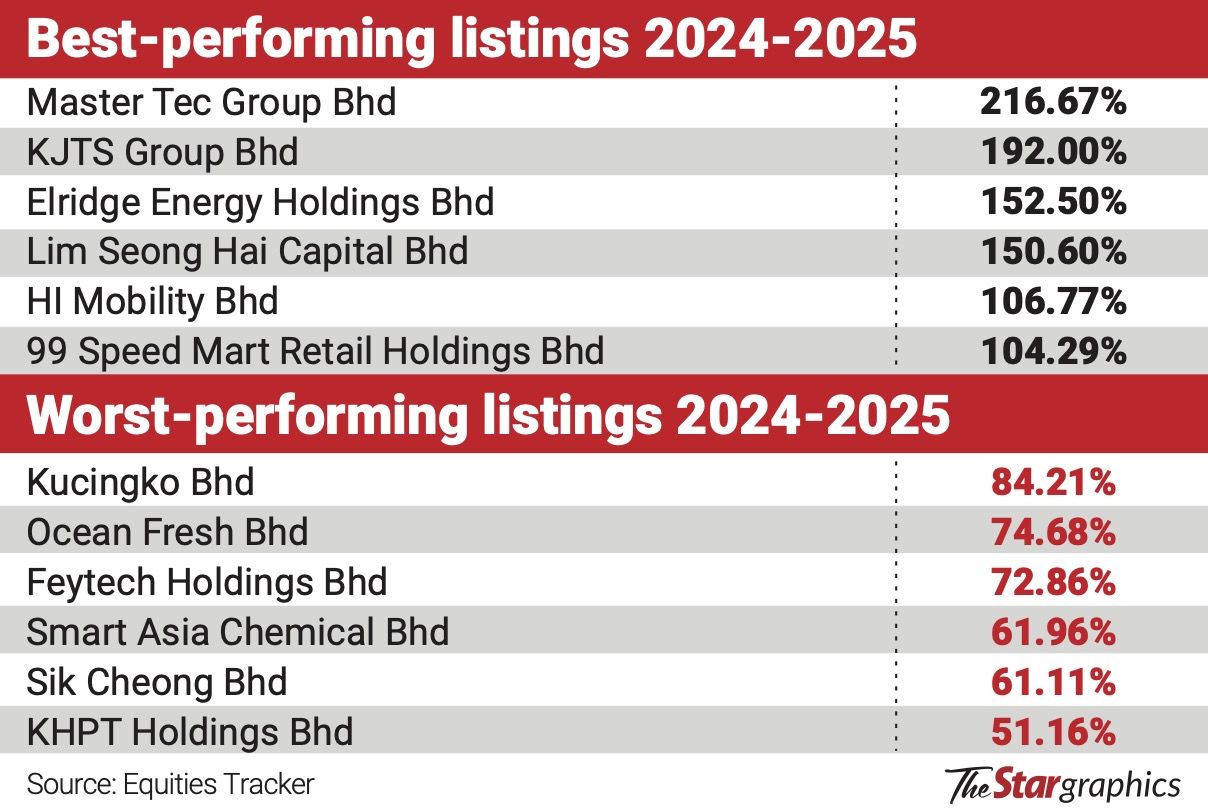
This was followed by building support services provider KJTS Group Bhd, whose stock increased 192%.
Among the worst performers were Kucingko Bhd – the first animation studio listed on the Malaysian stock exchange – which has seen its shares fall more than 80% since listing, and automotive cover and seat manufacturer Feytech Holdings Bhd, which dropped over 70% as at end-2025.
In terms of earnings, among companies with comparable figures for financial year 2024 (FY24) and FY25, Alpha IVF Group Bhd posted a higher net profit of RM57.5mil for FY25, up from RM52.9mil in FY24.
Vetece Holdings Bhd, an enterprise information technology company, also reported a higher net profit of RM4.2mil for FY25, compared with RM1.1mil the year before.
However, both companies saw their stocks finish 2025 in the red.
More time is needed to see whether these newly listed companies – and others that came to the market recently – can deliver steady earnings growth and gain the market’s confidence to value them accordingly.
Dearth of global firms
For now, most market experts agree that Bursa Malaysia still lacks large, global companies. Without them, attracting quality, long-term investors remains a challenge.
In the past two years, 99 Speed Mart Retail Holdings Bhd and Oriental Kopi Holdings Bhd have stood out, entering the market with market capitalisations of RM14bil and RM880mil, respectively.
Both benefit from scalable business models that can grow quickly at home and abroad.
Concerns about the shortage of similar quality listings are rising.
Peter Lim Tze Cheng, founder and chief research officer of Trident Analytics Sdn Bhd, notes a reverse trend may be underway.
“It depends on how we define a good listing. If we were to assess it by size, it can be said that we are on the reverse track where we are seeing more companies with good market capitalisation sizes being taken off the market – examples include UMW Holdings Bhd and Malaysia Airports Holdings Bhd.
“The new listings in the past few years have mainly been small-cap companies,” he tells StarBiz 7.
That said, Lim says to be fair, the regulators’ role is such that as long as companies fulfil the listing requirements, their role is to give the go-ahead.
“Also, ‘quality’ in terms of IPOs can be very subjective and hard to be taken as an assessment criterion.
“To give credit to Bursa Malaysia, they have been actively engaging with unlisted companies that have strong reputations in their industries and the potential to be listed,” he adds.
He notes that listings should be a way for companies to raise funds to expand, not an opportunity for shareholders to cash out entirely.
“If the intention of a listing is for the owners to exit, this is definitely a red flag.”
A senior banker who manages IPOs in the region says that as Malaysia moves toward a more disclosure-based market, regulators find it difficult to block companies from going public once listing requirements are met.
“An option is to tighten and raise listing requirements. Secondly, regulatory bodies must work hard to target quality companies for listing.
“After a company goes public, profits could fall for various reasons, which is why it is important to target quality companies in the first place,” he explains.
KPMG Malaysia head of capital markets Lam Shuh Siang adds that regulators can further ensure IPO quality by fine-tuning existing frameworks – such as the Securities Commission’s recent public consultation paper on market segmentation – reinforcing good governance, and maintaining close engagement with market participants.
“In addition, continued emphasis on the prominent roles of advisers and other capital market gatekeepers can help promote fair valuations and good market conduct. Collectively, these measures will further strengthen the overall quality of listings,” Lam says.
He emphasises the importance of promoters maintaining a meaningful stake in the company even after the IPO.
Their continued involvement usually leads to better decision-making and strategic direction, since they know the business inside out, Lam says.
“If they choose to leave the company after listing or exit entirely once the moratorium on their share ends, it can raise concerns among investors.
“Shareholders generally want to see promoters who are committed to building the business over the long term, rather than simply taking the opportunity to cash out, and leaving others holding the bag, so to speak,” he adds.
Kevin Chew, EY-Parthenon senior executive director at Ernst & Young PLT, says regulators should prioritise the sustainability of earnings and governance over the number of listings.
“This means closer scrutiny of business models, clearer disclosure on the use of proceeds, and firmer post-listing enforcement to build investor confidence,” he explains.
Chew points to the Securities Commission’s (SC) recent consultation seeking feedback on proposals – including raising Main Market profit thresholds and introducing flexibility for high-growth and renewable energy sectors – as an example of efforts to refine market segmentation and improve clarity for both issuers and investors.
“These are steps aimed at enhancing the quality and standard of listings,” he says.
Chew also notes that promoter commitment after listing is critical for investor confidence.
“A full or rapid promoter exit sends the wrong signal and erodes confidence. Investors want to see promoters who believe in the company’s future – viewing the IPO as the start of a new growth phase, not the finish line,” Chew adds.
PwC Malaysia deals partner Chan Weng Fai says the SC and Bursa Malaysia have raised the bar in recent years, especially on governance and sustainability, sending a positive signal to the market about listing quality.
“To further enhance current practices, regulators can look beyond headline profit track records and ask tougher questions on revenue quality, cash conversion and customer concentration, with clear disclosure on business model resilience and key risks,” he says.
Chan suggests that post-listing discipline and transparency could be strengthened by requiring detailed “use of proceeds” disclosures and quarterly reporting against committed milestones, so investors know how funds are being deployed.
He adds that while regulators set the guardrails, the ultimate responsibility lies with investment banks, auditors, directors and controlling shareholders to uphold best practices with integrity.
“If we play our part collectively, we’ll protect investors, keep share prices orderly and lower the cost of capital for Malaysian companies,” Chan says.
Where does Malaysia stand?
All said, KPMG’s Lam says Malaysia remains a credible platform for quality companies with realistic valuations and long-term plans.
“Malaysia has done well in terms of the number of IPOs in recent years, but we operate in a highly competitive regional landscape,” he notes.
He adds that Malaysia is often seen as a stable and well-regulated market, with Bursa Malaysia offering clear regulatory frameworks, strong governance standards and a relatively consistent approval process.
For mid-sized companies, family-owned businesses, and companies with strong domestic operations, Malaysia can be an attractive and practical listing venue, Lam says.
“Listing costs here are generally more manageable than in larger markets, and there is a solid base of local institutional and retail investors. That said, compared with some regional peers such as Singapore and Hong Kong, Malaysia faces stiff competition.
“Hong Kong tends to attract larger, high-growth companies, especially from Mainland China, and Singapore attracts more internationally oriented listings, particularly in tech and startups, thanks to deeper liquidity pools and the potential for higher valuations.
“Companies with regional or international presence may prefer larger bourses with more liquidity,” he explains.
Ernst & Young PLT’s Chew adds that Malaysia has historically been effective in attracting domestic mid-market listings, but more may need to be done to compete with regional peers like Singapore and Hong Kong for companies that are globally or regionally scalable.
“Growing market depth and building a reputation for quality and governance will be critical for Malaysia to position itself as a preferred destination for large, scalable, growth-oriented businesses,” he says.
Pwc’s Chan notes that compared to regional peers, Malaysia still needs to close the gap in a number of areas.
“This includes improving liquidity depth beyond attracting the largest names in key sectors.
“A broader sector mix, with more scaled ‘new economy’ listings, will be important for diversification beyond industries that typically attract investor interest, such as consumer and retail,” he says.
Chan points out that Malaysia’s regional counterparts have certainly not been resting on their laurels.
He calls Indonesia the “standout” in Asean in terms of funds raised, thanks to strong retail demand and compelling narratives spanning commodities, infrastructure, electric vehicles and digital platforms, which have supported higher valuations and turnover.
Singapore, he adds, is known for its “high governance and good international visibility”, although its IPO pipeline outside real estate investment trusts has been relatively thin.
Chan says Malaysia should also work on practices “that move the needle”. “This includes streamlining and digitalising the listing pipeline end-to-end to improve time to market and certainty for issuers. Regulators can also calibrate frameworks that matter to high-growth founders, including flexibility on share structures and pre-profit sectors, while still preserving strong investor protection,” he notes.