
Toyota still has the drive
GLOBALLY, Chinese carmakers have been nibbling away on market shares.
They offer aggressive prices, flashy models, and rapidly launch not just electric vehicles (EVs) but also internal combustion engine (ICE) models.
In Malaysia, they have already put pressure on automakers that have traditionally dominated the mid-to-upper-tier segments.
While national brands such as Perodua and Proton continue to command the affordable end of the market, non-national marques have seen their market share eroded.
Not UMW Toyota Motor Sdn Bhd (UMWT). The sole assembler and distributor of Toyota and Lexus vehicles in Malaysia is bucking the trend.
In the first 11 months of 2025, the Malaysian automotive market sold almost 728,000 cars.
National brands Perodua and Proton controlled 64% of the market, while UMWT held onto about 12% of total industry volume (TIV).
This shows the resilience of the Japanese marque amid rising competition and the stirrings of the EV transition.
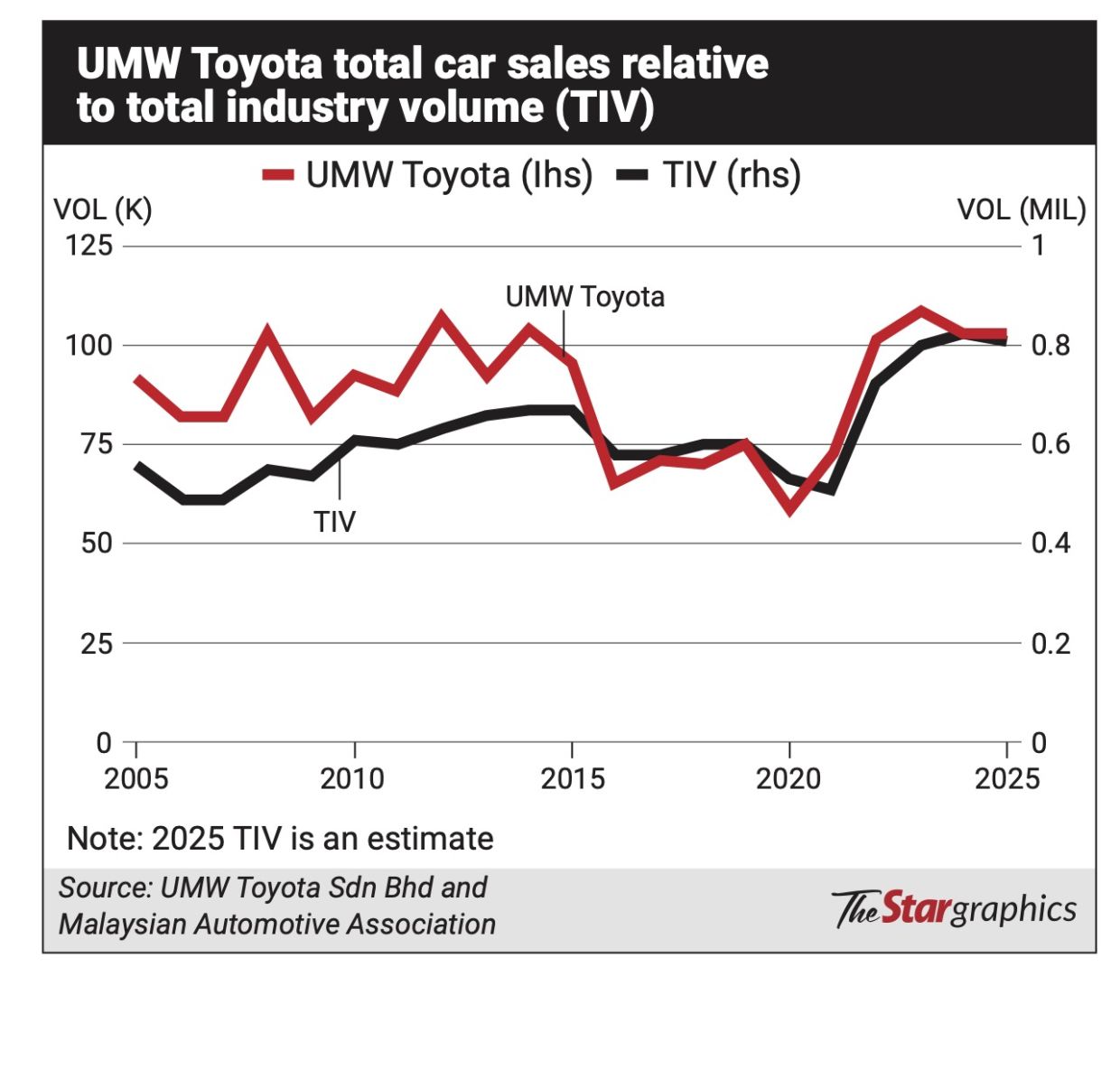
For the full year of 2025, UMWT sold 102,417 vehicles, surpassing the 100,000-unit mark for the fourth consecutive year.
Partly, this performance reflects record-high industry volumes in recent years, as Toyota’s sales have historically tracked overall TIV (see chart).
The achievement comes even as analysts had expected a slower year, with the industry navigating shifting policies, intensified competition and growing EV adoption.
UMWT president Datuk Ravindran Kurusamy, who assumed his role in 2017, credits the performance to disciplined execution across the organisation – from manufacturing and logistics to sales and after-sales service.
“Toyota’s strength has always been quality, service and reliability. That’s what keeps customers coming back,” he tells StarBiz 7, adding that the results were driven by the collective effort of the entire team.
Starting his career with the group in 1990, Ravindran worked on product pricing and marketing when UMWT sold about 6,000 vehicles a year in Malaysia.
It sells an average of 8,500 units a month today.
The 63-year-old rose through the ranks, gaining hands-on experience across different parts of the business, including assembly, logistics and market research.
“My early work in product pricing, advertising and research gave me an appreciation of how the entire Toyota value chain operates,” he recalls.
In 1991, Ravindran introduced a global operations system at UMWT, replacing paper-based reporting with a computerised platform that tracks sales, production, orders and inventory – a system he says continues to underpin the business today.
That foundation of disciplined execution and operational oversight has helped UMWT remain agile as the Malaysian automotive landscape shifts.
A multi-pathway bet
Today, as Chinese automakers accelerate EV rollouts and expand local production, the Malaysian market is entering a more structurally competitive phase.
For UMWT, the challenge will be to defend scale and margins while adapting its product mix for a market that is gradually electrifying.
Still, Ravindran sees the competition as an opportunity rather than a threat.
Drawing on lessons from past market shake-ups, particularly the entry of South Korean marques in the 1990s, he says UMWT will continue to compete on brand trust and product quality, even as rivals chase volume through price.
“We don’t fear competition. Customers will come back to quality, service and reliability,” he says.
Ravindran says UMWT is doubling down on hybrids and cost discipline as it navigates intensifying competition.
He says Toyota’s long-term bet on a multi-pathway strategy – spanning ICE, hybrids and battery electric vehicles (BEVs) – continues to anchor its approach in Malaysia, where petrol prices remain low and charging infrastructure is still limited.
“We are very clear in our multi-pathway strategy. Not everybody can drive an electric car today,” he says, pointing to infrastructure constraints, particularly for those living in high-rise homes.
“For the next 10 years, petrol, diesel and hybrid cars will still be around.”
Hybrid vehicles are emerging as a key growth pillar for UMWT, accounting for 11% of total sales volume in 2025, up from 7.5% in 2024.
Looking ahead, Ravindran expects hybrid sales in 2026 to reach around 20,000 units with the rollout of new mass-market models.
UMWT will launch the Vios Hybrid in February, marking the introduction of one of two new mass-market hybrid models planned for this year.
In addition, the company plans to introduce at least three other hybrid models, which will be imported in smaller volumes.
“As a businessman, I must see where the growth market is,” he says.
“We believe, right now, hybrid is the market. The infrastructure is better compared to electric cars, and petrol prices are low in Malaysia.”
While UMWT has introduced a few BEVs in Malaysia, including the Lexus’ RZ and Toyota’s bZ series, Ravindran says pricing remains a key constraint, with most mass-market EVs concentrated in the RM80,000 to RM120,000 range.
“Our electric models are priced closer to RM180,000 to RM250,000. There’s no point bringing them in just to fight on price,” he says, adding that more BEVs would be introduced “at the right time”.
UMWT has sold close to 200 Lexus BEVs, while Toyota’s bZ4, launched last year, moved around 10 units.
Cautious outlook for 2026
For 2026, UMWT expects sales to moderate, in line with industry expectations.
Ravindran says UMWT is targeting sales of between 90,000 and 95,000 units this year, about 7% to 12% lower than the 102,417 vehicles sold in 2025.
For the industry as a whole, Ravindran expects TIV of around 780,000 units.
“This year, we are still looking at around 780,000 units. The wind can blow in either direction, but I think the whole industry feels this will be the TIV for the year,” he says.
Ravindran says the outlook remains subject to downside risks from global politics and trade tensions, particularly potential US tariffs that could dampen broader economic activity.
“When there is a slowdown, it will automatically impact the car industry,” he says, adding that commercial vehicles such as the Toyota Hilux would be more exposed in a weaker environment.
While national brands continue to dominate the lower end of the market, Ravindran does not see this as a threat to UMWT’s positioning.
With Perodua selling about 350,000 units a year and Proton around 150,000 units, Toyota’s roughly 100,000-unit scale places it in a different competitive space, he says.
“When customers have a bit more spending power, they want to be in a slightly different class. That’s where brands like Toyota come in,” Ravindran says.
Ravindran adds that as customers move up the income curve or return for a second purchase, Japanese brands stand to benefit.
In that sense, he says the success of national marques helps to widen the customer base rather than shrink it.
“We see opportunity, not fear,” he says.
Steady order book, flexible capacity
UMWT currently has an order backlog of about 14,000 vehicles, equivalent to roughly one-and-a-half months of production, a level that Ravindran says has been sustained for the past six months and is expected to continue through 2026.
December 2025 marked Toyota’s strongest-ever monthly sales, with more than 14,000 units delivered, driven by year-end incentives, coordinated sales planning, and strong advertising.
“December is always a month when everyone pushes incentives to achieve targets,” Ravindran says.
On the manufacturing front, UMWT operates two assembly plants – in Shah Alam and Bukit Raja, Klang – with a combined installed capacity of 80,000 to 85,000 units a year and utilisation currently running at about 95%.
One plant is operating on two shifts while the other runs a single shift.
Ravindran says adding a second shift at the latter could lift total capacity to around 120,000 units.
Beyond that, he adds that UMWT has adjacent land available for further expansion should demand justify additional investment.
Policy shifts
On the government’s revised excise duty framework, Ravindran says the emphasis on higher local content and research and development is “fair” and positive for the industry.
The new open market value (OMV) rules in Malaysia incorporate various non-manufacturing and sales-related costs into the calculation base for locally assembled (CKD) vehicles, a change from the previous system that focused solely on manufacturing-related expenses.
Implementation of the new OMV method, originally scheduled for this month, has been deferred to June 30, 2026.
Industry players estimate that, once fully implemented, the expanded OMV could push prices of new CKD cars up by 10% to 30%, depending on the model and segment.
Ravindran stresses that existing models are not affected.
“The government is very clear: whatever the model code, if there is no change, it will run at the current price,” he says.
“Unless you introduce a new model with a new code, it will have to follow the new policy,” he adds, signalling that higher excise duties will only apply to future models.
Dealer-led model pays off
Meanwhile, UMWT’s decision to fully exit retail operations in 2017 and hand over all outlets to dealers was the “correct decision”, Ravindran says.
The move paid off during industry headwinds such as the Covid‑19 pandemic, when UMWT’s network remained robust with no dealer closures, he adds.
Today, all sales, after-sales, and body-and-paint operations are dealer-run, with Toyota’s nationwide network standing at 106 outlets.
Ravindran notes that of the roughly two million Toyotas sold in Malaysia to date, about 800,000 remain on the road.
He says around 500,000 customers return to Toyota workshops annually, generating approximately 1.4 million service visits.
Ravindran says UMWT’s revenue is now roughly split 50-50 between vehicle sales and parts and services.
“In the car industry, you make most of your money from car sales during good times, but during slower periods, discounts increase and margins shrink.
“Having a strong parts and service business helps balance that,” he explains.
UMWT is a joint venture between UMW Holdings Bhd, which holds a 51% stake, and Tokyo-listed Toyota Motor Corp and Toyota Tsusho Corp, with 39% and 10%, respectively.
It now sits under Sime Darby Bhd after the group acquired UMW Holdings for a total of RM5.8bil in 2024, bringing both Toyota and Perodua into its portfolio.
Ravindran describes Sime Darby as a “positive business attitude” shareholder.
On operational synergies, he says UMWT remains a stand‑alone business, although collaboration exists at the headquarters level on areas such as risk management and audits.
UMWT employs around 3,200 people, with no headcount reductions since the change in ownership.
About 85% work in manufacturing, while the remaining 15% are in corporate roles.