
Watts from water
NESTLED amid oil palm estates in Bestari Jaya, Kuala Selangor, a vast former tin mining pond is being transformed into one of South-East Asia’s largest floating solar facilities.
While Malaysia is already known for programmes that have encouraged the development of large-scale solar (LSS) power plants, with over 2GW in capacity built and another 4GW in progress, these projects are now turning to waterways.
One reason is the scarcity of land in developed areas. Based on estimates in the Malaysia Renewable Energy Roadmap (MyRER), the country has an estimated 16.6GW of floating solar potential at hydroelectric plants and dam reservoirs alone, which require slightly different expertise and equipment. (In Peninsular Malaysia, the potential is 5.2GW; the bulk is in Sarawak.)
As deployment scales, Malaysia could increasingly serve as a test bed for larger-capacity floating solar projects.
The Bestari Jaya project will have a capacity of 300MW.
It is undertaken by a consortium involving the Selangor government and private parties.
China state-backed Edra Power Holdings Sdn Bhd, which owns and operates five power plants in Malaysia –including the 2.2GW combined cycle gas turbine power plant, in Alor Gajah, Malacca, and the 50MW Kuala Ketil solar farm in Kedah – has a 49% stake in the Bestari Jaya project.
This project represents the first floating solar venture for the CGN group, encompassing both CGN Energy International Holdings Co Ltd (CGNEI) – the parent company of Edra Power – and its ultimate shareholder, China General Nuclear Power Corp (CGN).
Other consortium shareholders are the Selangor government-backed Worldwide Holdings Bhd with 40%, while Rotaka Engineering Services (M) Sdn Bhd holds the remaining 11% as a financial investor.
Rotaka supplies parts for the oil and gas and service turbine boiler, and provides technical support services.
The project was awarded under Malaysia’s LSS5 programme and is estimated to cost around RM1bil. Construction officially began on Feb 10.
The power purchase agreement (PPA) for the facility was signed in March last year for a 21-year tenure.
Over 80% of the facility will sit on water and is expected to generate enough electricity annually to power more than 150,000 households when commissioned in July next year.
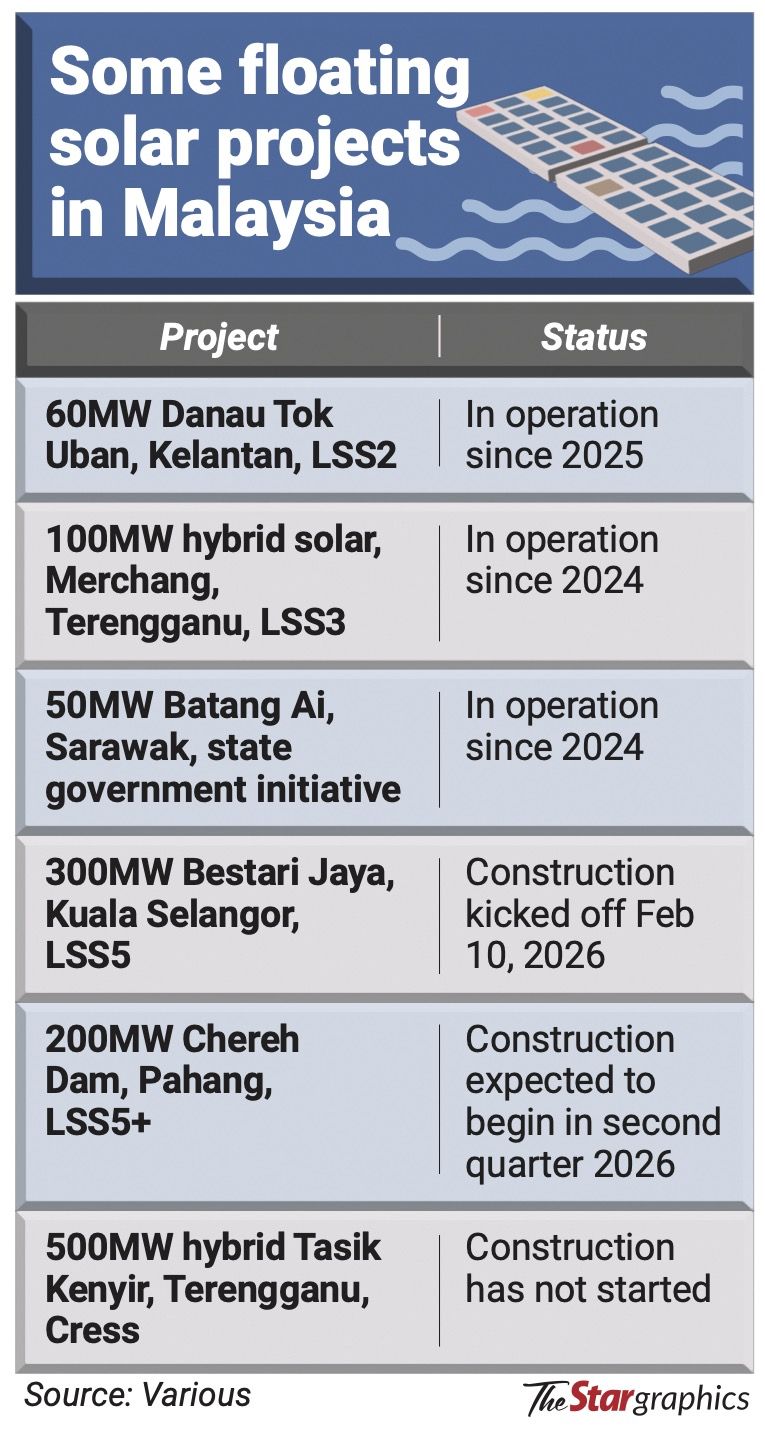
In Pahang, a 200MW floating solar project at Chereh Dam under the LSS5+ programme has been awarded to a consortium involving Citaglobal Bhd and United Arab Emirates-based Masdar – a global renewable energy (RE) company, which counts three Abu Dhabi-based energy and investment entities as shareholders.
The largest floating solar plant in Asean currently is the 145MW Cirata plant in West Java, Indonesia, which was developed by Masdar, together with Indonesia’s PLN Nusantara Power.
According to reports, there are plans to expand the Cirata plant by up to 500MW.
Coming back to the Chereh Dam project, Citaglobal’s executive director Aimi Aizal Nasharuddin says it is progressing as planned.
“The PPA signed on Dec 17, 2025, is a milestone and confirms the project’s compliance with the letter of notification issued on Sept 2.
“We are advancing the financing workstream with our lending partners and technical advisors. Structuring and due diligence activities are on track, and we are working towards financial close within the targeted timeline,” Aimi tells StarBiz 7.
Construction is expected to start in the second quarter of 2026 (2Q26), subject to completion of financing documentation and final regulatory approvals.
“The project will be the largest stand-alone floating solar installation in South-East Asia, developed as a 100% floating solar system without any hybrid ground-mounted component.
“This differentiates it from several recent large projects that adopt hybrid floating-and-land configurations,” Aimi adds.
With several such projects now building operational track records across the region, Aimi notes that their growing presence in Asean demonstrates “commercial bankability.”
That track record is also beginning to influence capital allocation decisions, says Cypark Resources Bhd chief investment officer Belqaizi Taufik, as investors increasingly view floating solar as an infrastructure asset class.
Cypark is one of the early movers in the floating solar segment and developed a 60MW floating solar plant at Tasik Danau Tok Uban in Kelantan under LSS2.
Sitting on a 167-acre site, the facility features 20 floating “islands” hosting nearly 250,000 solar panels and can power around 50,000 homes or roughly the size of a small town. Interestingly, the project is spurring tourism and recreational activities around the lake, creating extra local value.
Subsequently, under LSS3, Cypark undertook a 100MW hybrid floating and ground-mounted solar plant project in Merchang, Terengganu.
Both projects are now in operation, after several delays under the previous management.
The entry of the Jakel group, a bumiputra textile wholesaler, as shareholder in 2023 brought fresh capital to the projects.
Belqaizi, for one, believes the floating solar technology could “scale into a multi-gigawatt segment” of Malaysia’s RE mix over time.
This is given the abundance of under-utilised water bodies such as hydro reservoirs, lakes and former mining ponds.
The country also benefits from strong equatorial solar irradiance, while the natural cooling effect of water boosts generation efficiency for floating solar compared with land-based systems.
“Until now, the focus has largely been on ground-mounted solar, but floating installations are quickly proving their viability. Several such projects are already operational, with larger-scale developments now underway.
“As project sizes increase and financing structures strengthen, the technology is moving from early adoption to a proven, reliable infrastructure segment, supported by growing contractor capability,” Belqaizi tells StarBiz 7.
However, floating solar projects typically entail higher upfront capital costs because of the added engineering complexity such as specialised anchoring, mooring systems and site-specific installation requirements.
This has likely deterred some developers and partly explains the previously cautious policy stance.
However, as technology matures and project sizes grow, industry players note that the cost premium is gradually narrowing.
Competition for land
Plantation owners and industrial developers are increasingly earmarking acreage for RE, industrial parks and data centres, as these uses can generate higher returns per hectare compared to traditional crops such as oil palm.
But this raises the issue of how much productive agricultural land should be allocated to energy and infrastructure projects?
A case study in the MyRER on Malaysia’s large hydroelectric dams suggest that tapping about 10% of the Kenyir, Temenggor and Chenderoh reservoirs alone could deliver roughly 2GW, 1GW and 115MW of capacity, respectively.
Since these hydroelectric assets are owned by Tenaga Nasional Bhd, developers may also be able to leverage existing grid interconnection points, hence lowering interconnection costs.
At the same time, while rooftop solar remains an important part of distributed generation, such installations are typically limited by available roof space and structural constraints, industry observers say.
Cypark’s Belqaizi says the company recognised this land-use constraint early on.
“Our early conviction to pursue utility-scale floating solar under LSS2 was driven by the view that land availability, rather than solar resource quality or technology maturity, would become an increasing constraint to Malaysia’s RE expansion over time.”
The learning curve was steep, given the complex engineering involved.
“Lessons from these initial deployments have strengthened our execution capability across diverse site conditions and continue to differentiate Cypark from others,” he adds.
Fresh headwinds?
Even as developers become more adept at execution, cost dynamics across the solar value chain are emerging as a fresh area of concern.
China, the world’s largest manufacturer and exporter of solar photovoltaic modules, plans to phase-out certain export rebates from April, a development which will have a direct bearing on global equipment prices.
In a recent report, UOB Kay Hian Research projects module prices will rise to US$0.13 per watt by the 2Q26, from US$0.10 currently and an average of US$0.095 in 2025.
Solar modules account for 35% to 40% of project costs. Analysts earlier estimated that LSS5 and LSS5+ projects could generate internal rates of return in the high single-digits. To preserve returns, developers are likely to adopt tighter cost discipline, particularly in procurement and project execution.
Setting the standard
The Bestari Jaya and Chereh Dam projects will be closely watched, serving as reference points for future floating solar developments in the region.
Edra Power’s chief safety officer, Oscar Huang, acknowledges that the 430 ha former mining site in Bestari Jaya presents geotechnical and water-depth variability, requiring careful planning and meticulous execution.
To manage the risks, Huang says it will apply international best practices and proven engineering solutions and work closely with consortium partners and contractors.
He says through CGNEI’s regional footprint, the project could also serve as a springboard for future floating solar developments both domestically and across the region.
Another upcoming project is the 500MW hybrid hydro floating solar plant at Tasik Kenyir, Terengganu, under the Corporate Renewable Energy Supply Scheme (Cress).
Here, Cypark is partnering with Terengganu Inc Sdn Bhd and TNB Power Generation Sdn Bhd, which will design, build and operate the RM2bil plant.
It will harness Tasik Kenyir’s water, combining solar energy production and battery storage.
Meanwhile, in Sarawak, a 50MW floating solar farm at the Batang Ai hydroelectric reservoir began generating power in late 2024, forming a hybrid hydro‑solar facility.
Plans are underway to expand Batang Ai by another 120 MW, while the Sarawak government is exploring similar projects at the Bakun, Murum and upcoming Baleh dams.
Belqaizi believes hybrid configurations will emerge as a natural evolution of the market, which is shifting towards solutions that can deliver value beyond pure energy generation.
“Combining solar with energy storage, or integrating solar with existing hydroelectric infrastructure, allows projects to capture value beyond basic electricity sales.
“Floating solar can also be deployed under Cress, which is already demonstrating strong commercial viability,” he adds.
However, grid interconnection remains key. Even large water bodies cannot support projects economically without viable grid access, industry players say.