
Is Visa Stock Going to $1,000?
Key Points
Visa shares have generated a more than fourfold total return in the past 10 years, driven by durable revenue and profit gains.
Based on its impressive financial profile and network effect, this business deserves its premium valuation.
Assuming a 12.5% annualized increase in earnings per share, Visa stock will reach $1,000 in a decade.
Visa (NYSE: V) is one of the most dominant forces in the world of payments. Just in the latest fiscal quarter (Q1 2026, ended Dec. 31), it handled a whopping $4.5 trillion in payment volume. It's available in 200 countries and territories. And there are billions of its cards in use around the globe.
No one will argue about the merits of this company, but investors are certainly wondering about the upside potential of its stock. Some are even wondering if this stock can hit major milestones. For instance, can this financial stock increase 208% from its current price of $324.33 (which is 13% below its peak) to reach $1,000 per share in the future?
Will AI create the world's first trillionaire? Our team just released a report on the one little-known company, called an "Indispensable Monopoly" providing the critical technology Nvidia and Intel both need. Continue »
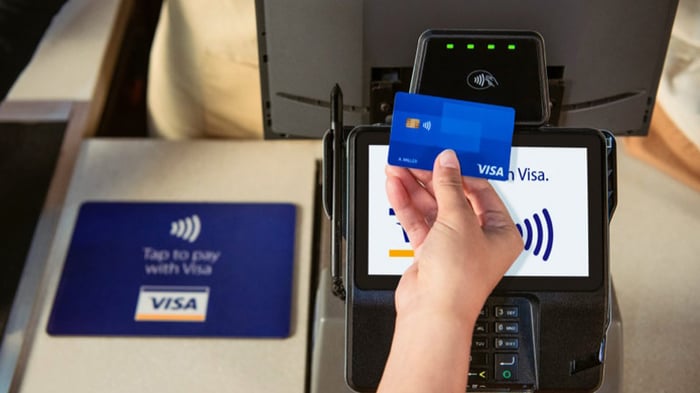
Image source: Visa.
Looking at the past
Over the last decade, Visa's stock has climbed by 338% (as of March 4). So shareholders are accustomed to seeing strong gains historically that outperform the S&P 500 index.
The most important tailwinds, unsurprisingly, are ongoing revenue and profit growth. Between fiscal 2015 and fiscal 2025 (ended Sept. 30, 2025), Visa's net revenue increased by 200%. At the same time, its diluted earnings per share (EPS) climbed 380%.
The company handles more payment volume each year, with a higher number of active cards and merchant acceptance locations, as cashless transactions continue to become more widespread. What's more, Visa's powerful network effect, supported by its two-sided ecosystem, creates its wide economic moat. This drives financial performance.
However, this is a more mature business in 2026. Visa carries a sizable market cap of $619 billion. And going forward, growth should naturally moderate.
Earnings will drive investment gains
Visa usually never qualifies as a cheap stock. Right now, the price-to-earnings (P/E) ratio is 30.4. This represents a 21% premium to the overall market.
I believe the stock deserves to trade at the current multiple, though. This is an extremely high-quality business, based on its robust profits, durable growth, and impressive competitive position. Consequently, we can probably assess that shares are fairly valued today.
This means that in the future, it's reasonable to expect the stock to produce a long-term return that is roughly in line with bottom-line growth. This assumes that the P/E ratio stays the same.
Between fiscal 2025 and fiscal 2028, Visa's EPS is projected to rise at a compound annual rate of 12.5%, according to analysts. A low-double-digit or high-single-digit pace of growth is probably what investors will see in the long run.
Based on the 12.5% annualized EPS growth outlook, Visa stock will reach $1,000 in a little over 10 years. This would be less than what was achieved in the past decade, but it's a solid outcome.
Neil Patel has no position in any of the stocks mentioned. The Motley Fool has positions in and recommends Visa. The Motley Fool has a disclosure policy.